IQ & reasoning • 6 min read • By RareScore Research Desk • Published 2026-10-03 • Updated 2026-10-03
Is 130 IQ Good? Percentile, Rarity, and What It Actually Means
An IQ of 130 sits two standard deviations above the mean on standard scales—around the 98th percentile, or roughly 1 in 44 people. Learn what that means and what it does not prove.
What to know before reading further
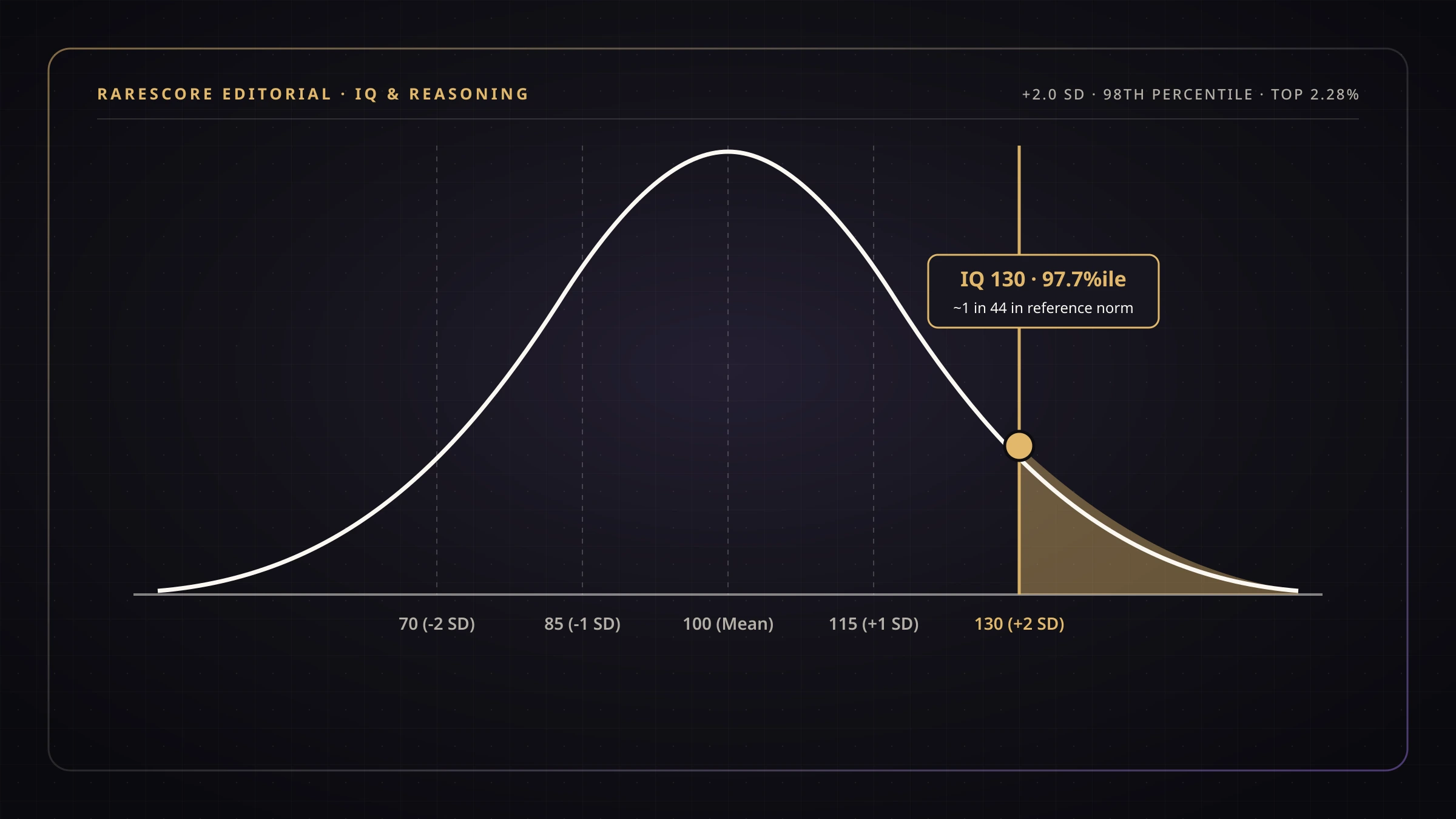
- On standard intelligence scales (mean 100, standard deviation 15), an IQ of 130 is two standard deviations above average—roughly the 97.7th percentile, or about 1 in 44 people.
- Many clinical manuals label the 130+ region "Very Superior" or "Extremely High," and many gifted or high-IQ programs use 130 as a reference cutoff alongside other evidence.
- The exact percentile depends on the scale's standard deviation: on an SD 16 instrument, 130 is about +1.875 SD (~97th percentile); on an un-normed web quiz, 130 has no verified population rank.
- High abstract reasoning speed does not guarantee sound judgment, domain mastery, or emotional regulation—subtest balance and real-world habits still carry the outcome.
This guide answers: Understand whether an IQ of 130 is high, what percentile and rarity it corresponds to on standard scales, and how to separate online estimates from clinical evaluations.
What the +2 SD threshold actually measures
Yes—on a standard IQ scale with a mean of 100 and a standard deviation of 15, an IQ of 130 is very high. It sits two standard deviations above the mean, near the 98th percentile, which corresponds to roughly 2.3% of the reference population (about 1 in 44 people). That makes 130 a common threshold in discussions of high cognitive performance, though the number only carries that exact statistical meaning when you know which test produced it.
For the broader scale from average through high ranges, start with What Is a Good IQ Score? and the full IQ score ranges and percentiles chart. This article focuses specifically on why 130 is treated as a landmark score, how different scales shift its percentile, and where a single composite number stops being informative.
Percentile and rarity for a 130 IQ
Most modern clinical intelligence batteries—such as the Wechsler scales—use a standard score centered at 100 with a standard deviation (SD) of 15. Under a normal distribution with those parameters:
- Distance from the mean: +2.0 standard deviations above 100.
- Percentile rank: approximately the 97.7th percentile (often rounded to the 98th percentile in reports).
- Share of the reference group at or above 130: roughly 2.28%, or about 1 in 44 test-takers.
- Typical qualitative descriptor: traditionally labeled "Very Superior" on older Wechsler tables and "Extremely High" on newer editions.
One technical check always comes first: confirm the standard deviation of the test. A few scales use SD 16 (where +2 SD lands at 132 rather than 130) or SD 24. On an SD 16 scale, a 130 sits at +1.875 SD—still around the 97th percentile, but slightly below a two-standard-deviation cutoff. And on an un-normed internet quiz, "130" is just an arbitrary label unless the publisher documents its reference distribution; see What Does an IQ Score Mean?.
Why 130 shows up in gifted and Mensa cutoffs
The number 130 appears repeatedly across school policies and high-IQ societies because two standard deviations above the mean is a clean statistical boundary on an SD 15 bell curve:
- Roughly the 98th percentile (+2 SD) is the benchmark used by many high-IQ organizations, including Mensa, on approved supervised tests.
- Many school districts reference scores around 130 as one criterion in gifted-and-talented screening, though modern programs increasingly combine cognitive scores with achievement samples, teacher observations, and multiple pathways.
- Because every cognitive test has measurement error (often a 95% confidence interval spanning several points on either side of the observed score), psychometric guidelines warn against treating 129 and 130 as two different kinds of human beings.
Any program or admissions decision that hinges on a two-standard-deviation cutoff requires a proctored, professionally normed evaluation—not an unsupervised browser score. For how those two formats differ in construction and validity, read free IQ test vs professional IQ test.
What a 130 IQ usually looks like in practice
On the cognitive tasks that load heavily on general reasoning, people scoring near the 98th percentile often show noticeable strengths in:
- Pattern abstraction: spotting the underlying rule in novel sequences, matrices, or quantitative relationships with fewer examples.
- Verbal and conceptual compression: linking unfamiliar concepts quickly and holding multiple constraints in working memory at once.
- Learning rate on structured problems: picking up formal systems, analytical frameworks, or technical rules faster than average when starting from scratch.
Equally important is what a 130 composite score does not tell you:
- Subtest tilt: two people can both reach a 130 full-scale composite with very different profiles—one driven by exceptional verbal comprehension and average spatial speed, the other by rapid nonverbal matrix reasoning and average vocabulary.
- Cognitive biases under haste: high fluid reasoning does not immunize anyone against framing traps, overconfidence, or intuitiva shortcuts when rushing; see Why Smart People Miss Trick Questions.
- Conscientiousness and follow-through: long-term creative, academic, or professional output depends heavily on sustained practice, self-regulation, and interpersonal judgment (compare with EQ vs IQ).
Online 130 vs clinical 130
Scoring 130 on a short online quiz and scoring 130 on a proctored clinical battery are two very different events:
- Many casual web quizzes inflate scores into the 125–140 band to encourage social sharing and certificate purchases.
- Short 10-question or 15-question runs carry wider uncertainty than full multi-subtest batteries; a lucky guess or a single misread prompt shifts the estimate noticeably.
- Unsupervised testing cannot control for noise, screen size, prior exposure to similar matrix items, or timing interruptions.
For a deeper breakdown of what online reasoning tests can legitimately estimate, read How Accurate Are Online IQ Tests?.
RareScore's free IQ test is built as a transparent online estimate across five reasoning domains—pattern, logic, numerical, verbal, and spatial—in 10, 20, or 30 questions. It gives you a clear category breakdown and percentile estimate without pretending to be a clinical diagnosis; you can inspect the scoring model directly in our methodology.
Frequently asked questions
Is an IQ of 130 considered genius?
Modern clinical manuals generally avoid the word "genius" because creative or scientific eminence requires domain mastery, persistence, and originality beyond test-taking skill. On standard SD 15 scales, 130 is classified as "Very Superior" or "Extremely High" (around the 98th percentile).
How rare is a 130 IQ?
On a standard normal distribution with a mean of 100 and a standard deviation of 15, scores of 130 and above occur in about 2.28% of the reference population—roughly 1 in 44 people.
Can you get a 130 IQ by practicing?
Familiarity with matrix, sequence, and logic formats can reduce test anxiety and prevent careless timing mistakes, which may raise an observed score toward your true ceiling. Practice mostly trains item-format fluency rather than transforming general cognitive capacity overnight; see how to improve logical reasoning.
Two 130 profiles with completely different strengths
Imagine two examinees who both finish a multi-domain reasoning battery with an overall estimate near 130. Examinee A scores near the 99th percentile on verbal analogies and logical deduction, and near the 80th percentile on spatial rotation and timed numerical series. Examinee B shows the inverse pattern: near the 99th percentile on spatial matrices and numerical rules, and near the 82nd percentile on verbal nuance.
If both only read the headline "130," they walk away with the same badge and miss the practical takeaway. Examinee A will feel effortless in argument analysis, legal or policy reading, and conceptual synthesis, yet may need deliberate diagramming when tackling 3D geometry or quantitative modeling. Examinee B will see structural and quantitative patterns rapidly, yet may need extra passes to unpack dense verbal ambiguity. Looking past the single number to the domain profile is where a high score becomes useful.
Use this checklist
- Did you verify whether the test uses a standard deviation of 15, 16, or an un-normed scale?
- Have you read the percentile (~98th on SD 15) alongside the confidence interval around the score?
- Did you inspect the domain breakdown (verbal, logic, pattern, numerical, spatial) instead of just the composite?
- Are you separating an unsupervised online estimate from a proctored clinical evaluation?
- Have you paired cognitive test feedback with real-world habits in judgment, focus, and follow-through?
What the evidence supports
An IQ of 130 is a strong benchmark on any properly scaled assessment—sitting two standard deviations above the mean near the 98th percentile—yet its real value lies in the profile behind the number and how you use that reasoning capacity under everyday conditions. To see your own breakdown across logic, pattern, numerical, verbal, and spatial tasks with no sign-up wall, try RareScore's free IQ test and compare your result on the IQ score ranges and percentiles chart.
About the RareScore Research Desk
This guide was reviewed for claim strength, source quality, originality, and practical usefulness. The Research Desk is an editorial function, not a licensed clinical service. See the editorial standards and writing-process disclosure.
Sources and further reading
- APA Dictionary of Psychology — Intelligence Quotient (IQ)
- Gottfredson, L. S. (1997). Mainstream Science on Intelligence — Intelligence
- Neisser, U., et al. (1996). Intelligence: Knowns and Unknowns — American Psychologist
- Deary, I. J., Penke, L., & Johnson, W. (2010). The Neuroscience of Human Intelligence Differences — Nature Reviews Neuroscience
- AERA, APA, & NCME — Standards for Educational and Psychological Testing