IQ & reasoning • 5 min read • By RareScore Research Desk
Why Smart People Still Miss Trick Questions
The cognitive shortcuts behind tempting wrong answers—and how to distinguish clever wording from genuine reasoning difficulty.
What to know before reading further
- The first plausible answer can arrive before the question has been fully represented.
- High ability does not eliminate overconfidence, ambiguity, or motivated reasoning.
- Some “trick” questions are simply poorly written; difficulty should come from reasoning, not hidden wording.
- The best correction is to identify the cue that triggered the wrong model of the problem.
This guide answers: Explain intuitive errors, conflict detection, overconfidence, and ambiguity in trick and best-answer questions.
Ability can accelerate the wrong model
A fast thinker can generate a plausible interpretation quickly and then use considerable reasoning power to defend it. This is one reason intelligence does not eliminate trick-question errors. Once the problem has been framed incorrectly, stronger verbal or analytical ability may produce a more elaborate justification rather than a correction.
The useful skill is not permanent suspicion of every easy answer. It is conflict detection: noticing when the wording, quantities, or answer choices do not fit the first model cleanly. A fair trick question rewards that second look. An unfair one depends on a hidden convention or grammatical trap that the question never gives the solver reason to inspect.
Fast recognition can become a trap
Knowledge and experience help the brain recognize familiar structures quickly. That is usually useful. A trick question exploits the moment when familiarity arrives before the conditions have been checked.
The wrong answer often feels good because it resembles a problem you already know.
The hidden assumption is usually the real question
Some problems are difficult because they require calculation. Others are difficult because the prompt leaves room for an unsupported assumption.
A strong solver asks what must be true, what is merely likely, and what the question never actually said.
Confidence rises faster than accuracy
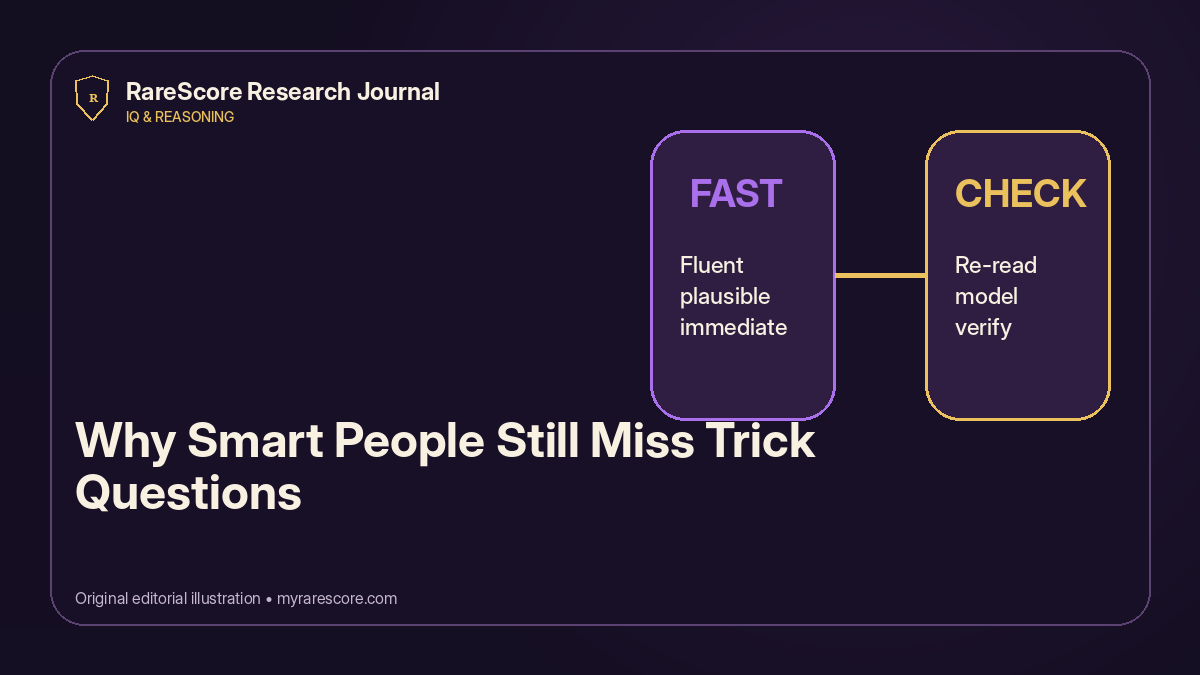
When an answer is produced fluently, people often interpret the ease as evidence that it is correct. This is why simple-looking items can produce more careless errors than complex ones.
A useful habit is to spend an extra few seconds on the easiest-looking question and identify the most tempting alternative.
Overthinking creates the opposite error
Once people know a test contains traps, they may reject the straightforward answer simply because it looks too easy. That replaces one bias with another.
The goal is not suspicion. It is verification. The correct answer can be simple when it satisfies every condition.
Several answers can be possible while one is strongest
Real reasoning is often about support rather than absolute possibility. One option may be technically possible but require an extra assumption. Another may explain more evidence with less speculation.
This is why high-quality tests sometimes use weighted or best-answer scoring rather than pretending every plausible alternative is equally wrong.
A five-second checking routine
Before submitting, ask whether you answered the exact question, used every condition, assumed anything unstated, and confused “can” with “must.”
That small pause catches a surprising number of errors without turning every question into a debate.
The line between a fair trap and bad wording
A fair trick question rewards careful use of information supplied in the prompt. A bad question depends on an obscure interpretation, missing context, or the writer’s private intention.
Best-answer scoring can help when several responses are possible. The explanation must show why one answer requires fewer assumptions or follows more strongly from the evidence.
Metacognition is the real advantage
Strong solvers monitor not only the problem but also their own confidence. An answer that arrives instantly may deserve a check; an answer that required complex work may deserve simplification.
This habit is not endless doubt. It is a brief test of whether confidence came from evidence or familiarity.
- Restate the exact question
- List any assumption you added
- Test the tempting alternative
- Distinguish possible from necessary
- Stop once every condition is satisfied
Common questions
Are trick questions a good IQ measure? A few can test assumption control and reflection, but a test made entirely of word tricks measures familiarity and caution more than broad reasoning.
Why do experts sometimes miss easy questions? Expertise creates strong expectations. When a problem resembles a familiar pattern, the expected solution may arrive before the changed condition is noticed.
Should every answer explanation be obvious afterward? It should be defensible and tied to the wording. Surprise alone is not evidence of a good item.
When the “obvious” answer deserves a second model
A bat and ball cost $1.10 in total, and the bat costs $1 more than the ball. The immediate answer—ten cents—arrives because the numbers fit the wording fluently. But ten cents makes the bat $1.10 and the total $1.20. The correct answer is five cents. The lesson is not that fast thinking is bad; it is that fluency can masquerade as verification.
Best-answer questions create a related challenge. Several options may be technically possible, but one requires fewer unsupported assumptions or follows more directly from the evidence. A solver who searches only for possibility may defend a weaker answer. A solver who searches for comparative support asks which option remains strongest after the same standard is applied to every choice.
A practical check takes seconds: restate what is being asked, compute or paraphrase the first answer, and search for one fact that would make it fail. If no such fact is visible, proceed. If the wording remains genuinely ambiguous, the problem may be poorly designed rather than cleverly difficult.
Use this checklist
- Restate the question before solving it.
- Verify the first fluent answer with a calculation or counterexample.
- Compare all options using the same evidentiary standard.
- Distinguish deliberate ambiguity from poor wording.
- Review the model of the problem, not only the final answer.
What the evidence supports
The strongest solver is not the person who distrusts every simple answer. It is the person who knows when simplicity has been verified and when it has merely felt fluent. That distinction depends on metacognition: noticing the model being used, the confidence attached to it, and the evidence that could break it. Intelligence supplies tools; disciplined checking decides whether those tools are aimed at the right problem. A useful review therefore records the lure, not only the correction: which interpretation arrived first, which cue made it feel sufficient, and what evidence would have forced a slower model. That record turns a clever puzzle into a transferable lesson about calibration. Without it, the solver may remember the trick while preserving the same reasoning habit that made the trick effective. The aim is better transfer, not better trivia.
About the RareScore Research Desk
This guide was reviewed for claim strength, source quality, originality, and practical usefulness. The Research Desk is an editorial function, not a licensed clinical service. See the editorial standards and writing-process disclosure.