IQ & reasoning • 5 min read • By RareScore Research Desk
Free Online IQ Test vs. Professional IQ Assessment
Compare free online IQ tests with professionally administered assessments, including purpose, supervision, norms, cost, interpretation, and appropriate use.
What to know before reading further
- Use an online test for low-stakes curiosity, practice, and structured feedback.
- Use a professional assessment when eligibility, diagnosis, accommodations, placement, or legal decisions are involved.
- Professional assessment adds controlled administration, instrument selection, behavioral observation, and individualized interpretation.
- Price alone does not establish quality; published evidence and appropriate use do.
This guide answers: Decide when an online estimate is sufficient and when a standardized professional assessment is necessary.
The real difference is the chain of evidence
The difference between a free online test and a professional assessment is not simply the number of questions or the price. It is the chain connecting the result to a decision. Professional assessment controls administration, selects an instrument for a stated referral question, observes behavior, applies validated norms, and produces an interpretation for a defined use.
An online test can still be thoughtfully designed and genuinely useful. Its appropriate promise is narrower: a challenging sample of reasoning and a transparent estimate under uncontrolled conditions. Trouble begins when convenience is marketed as equivalence or when a professional-looking score is used to support decisions the instrument was never built to carry.
They solve different problems
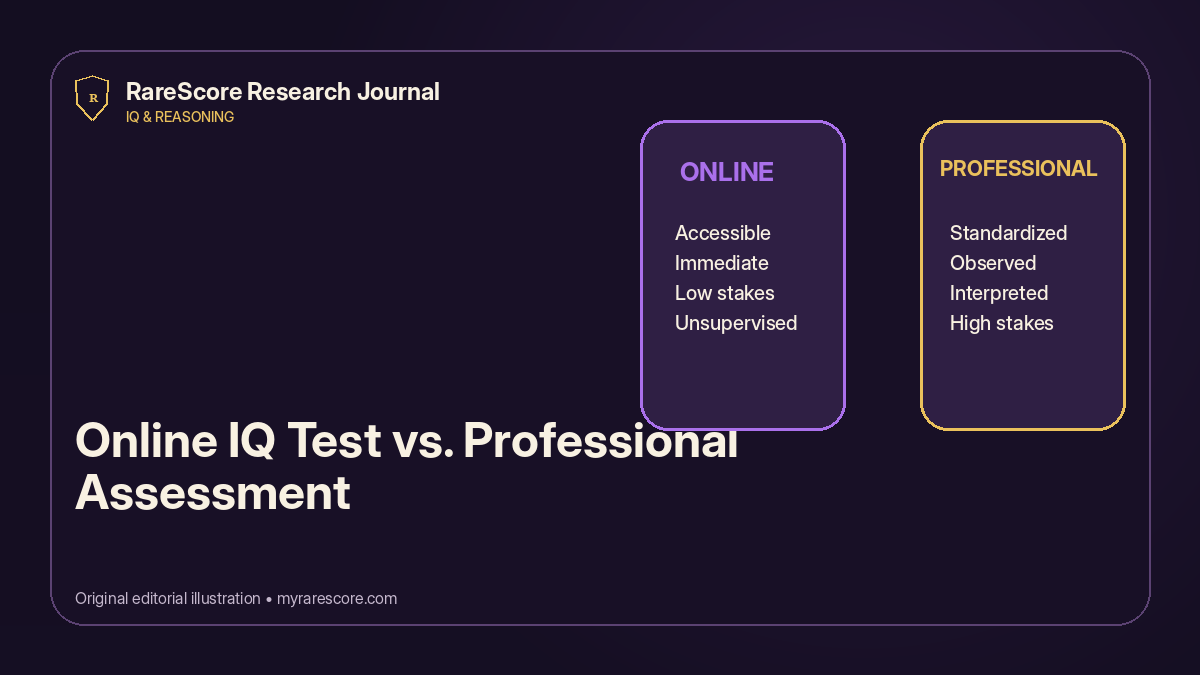
A free online IQ-style test is usually designed for curiosity, challenge, practice, or a quick estimate. A professional cognitive assessment is selected and administered to answer a specific educational, clinical, or legal question. The difference is not simply that one costs money.
Professional testing includes standardized administration, identity and age verification, controlled instructions, norm-referenced scoring, observation, and interpretation by a qualified examiner. An online test trades much of that control for accessibility and speed.
What a good online test can do well
An online test can provide immediate access to varied reasoning problems, category-level feedback, and a repeatable way to observe your approach to unfamiliar tasks. It can also introduce people to concepts such as percentiles, bell curves, and cognitive strengths without requiring an appointment.
The best online tests are transparent about their limits. They do not claim to diagnose giftedness, learning disability, or intellectual disability, and they do not present a model-based score as equivalent to a professionally normed result.
What professional assessment adds
A professional examiner can select an instrument appropriate for the person’s age, language, referral question, and abilities. The examiner can observe effort, frustration, strategy, misunderstanding, motor limitations, and behavior that a website cannot see.
Professional reports may interpret multiple indexes, confidence intervals, significant subscale differences, and relevant history. That level of interpretation matters when the result will influence services, accommodations, placement, or diagnosis.
Testing conditions change comparability
At home, a person may be interrupted, use a calculator, receive help, switch devices, or complete the test while tired. Those conditions do not make the experience useless, but they reduce comparability with a standardized administration.
For a cleaner online result, take the test alone, use a stable screen, avoid outside tools, and complete it in one sitting. The site should also disclose whether time affects scoring.
Price does not automatically prove quality
A paid online quiz can still use weak questions and inflated scoring. A free test can be thoughtfully designed and transparent. Quality depends on evidence, not price alone.
Professional assessment costs more because it includes licensed time, controlled administration, proprietary instruments, scoring, interpretation, and a report tailored to the referral question. That service is fundamentally different from purchasing access to a score page.
Which option should you choose?
Use an online test when you want a challenge, a personal benchmark, practice, or a low-stakes estimate. Use professional assessment when a school, employer, clinician, court, or accommodation process requires defensible standardized evidence.
When in doubt, ask what decision will be made from the score. The higher the stakes, the stronger the measurement and professional interpretation should be.
Retakes and practice effects
Repeating the same online items can improve the score through familiarity. You may remember the answer pattern or learn the expected trick without a broad change in reasoning ability. A serious retake should use fresh items or clearly disclose the practice effect.
Professional examiners also consider previous exposure to instruments when selecting and interpreting tests. The timing of a retest may matter when the result is used for a formal decision.
Questions to ask before trusting either option
Ask what the assessment measures, how long it takes, who the comparison group is, and what decisions the result is designed to support. For professional services, ask about examiner qualifications, the report, and whether feedback is included.
For online tests, look for a methodology page, transparent limitations, a meaningful breakdown, privacy controls, and a result that provides value before requiring payment.
Choose by consequence, not curiosity
A person who wants an evening challenge does not need a clinical appointment. A well-designed online test can provide difficult items, immediate explanations, and a useful category breakdown. The appropriate cost and evidence are proportional to the low-stakes question.
A student seeking accommodations, a family evaluating a learning concern, or a clinician considering a diagnosis faces a different problem. The result may affect services, identity, and long-term decisions. The assessment must therefore support stronger inferences, document conditions, consider alternative explanations, and be interpreted by someone qualified to integrate the score with history and observation.
A simple rule helps: ask what happens if the score is wrong. If the consequence is mild and reversible, an online estimate may be enough. If the consequence is substantial, formal, or difficult to reverse, use an assessment designed for that decision.
Use this checklist
- Match the assessment strength to the consequence of error.
- Use online testing for curiosity, practice, and low-stakes feedback.
- Use professional testing for diagnosis, eligibility, or accommodations.
- Ask what report and feedback are included.
- Do not assume that a paid online quiz is professionally validated.
What the evidence supports
The right assessment is the one designed to support the decision in front of you. An accessible online challenge can be excellent at what it promises and still be inappropriate for accommodations or diagnosis. A professional evaluation can be necessary without being a perfect or complete account of intelligence. Clear scope is not a weakness; it is the basis of trustworthy measurement. The practical decision rule is purpose-based. Use a transparent online test for curiosity, practice, and low-stakes self-observation. Use a qualified professional when accommodations, diagnosis, educational placement, disability documentation, or a major life decision depends on the result. The more serious the consequence, the more important controlled administration, appropriate norms, score uncertainty, and contextual interpretation become. Match the instrument to the consequence.
About the RareScore Research Desk
This guide was reviewed for claim strength, source quality, originality, and practical usefulness. The Research Desk is an editorial function, not a licensed clinical service. See the editorial standards and writing-process disclosure.