IQ & reasoning • 6 min read • By RareScore Research Desk
What Is a Good IQ Score? Ranges, Percentiles, and Context
Understand what people mean by a good IQ score, how common score ranges relate to percentiles, and why the test and comparison group matter more than a single label.
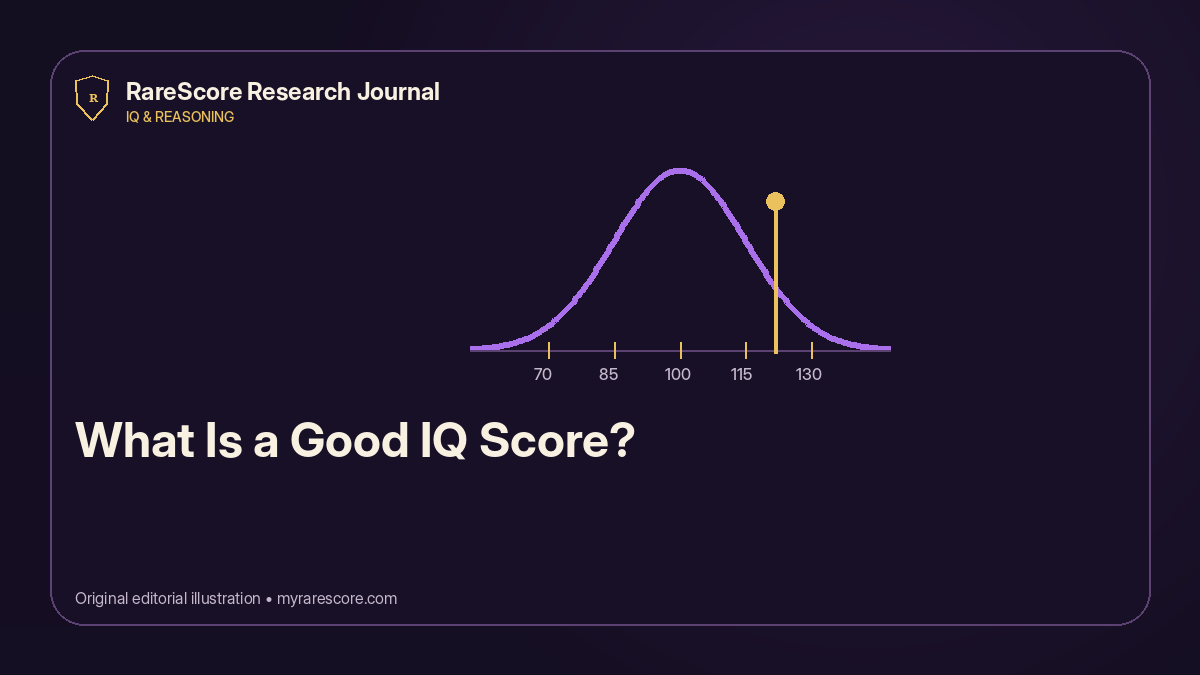
What to know before reading further
- On many modern scales, 100 is near the reference-group average.
- The word “good” depends on the decision being made; a score is not a moral or personal ranking.
- Small score differences may fall inside expected measurement uncertainty.
- Subscale patterns and testing conditions can matter more than a single category label.
This guide answers: Interpret IQ scores without turning a standardized comparison into a judgment of personal worth.
“Good” is a use-word, not a measurement word
Psychometrics can describe where a score sits in a reference distribution. It cannot decide whether that score is “good” without knowing the purpose. A result that is sufficient for one educational task may be irrelevant to another; a high reasoning score may be useful for complex analysis but say little about persistence, judgment, creativity, or the ability to work with people.
The more consequential the question, the less useful the adjective becomes. For casual curiosity, “above average” may be enough. For accommodations or diagnosis, the interpretation requires standardized administration, confidence intervals, subscale patterns, developmental context, and qualified judgment. The number does not become more meaningful merely because the label sounds impressive.
A “good” IQ score depends on the question you are trying to answer
People often ask for one cutoff that separates a good IQ score from an ordinary one. That framing is tempting because it turns a complicated measurement into a simple status label. A better interpretation begins with purpose. Are you trying to understand performance on a reasoning test, compare a result with a reference group, identify a strength, or make a high-stakes educational decision?
Most IQ scales are constructed so the center of the reference distribution is near 100. A result above the center indicates stronger performance on the sampled tasks relative to that group. It does not mean the person is better at every kind of thinking, and it does not describe creativity, judgment, persistence, social understanding, or practical skill.
Common IQ score ranges are descriptive, not identities
Labels such as average, above average, superior, or very high are conventions used to summarize a continuous distribution. The exact boundaries vary across tests and publishers. Two instruments can use similar score scales while sampling different abilities, applying different time limits, and relying on different norming groups.
A useful report should therefore show the test name, the score scale, the estimated percentile, and a category breakdown. Treating a range label as a permanent identity removes the uncertainty and context that responsible interpretation requires.
- Around 100 is typically near the reference average
- A difference of a few points may not be meaningful
- Percentiles communicate relative standing more intuitively
- Subscale patterns can be more useful than the total score
Percentile tells you how unusual the result was in the reference group
A percentile is not the percentage of questions answered correctly. It estimates the share of the reference group that scored below the observed result. A person at the 84th percentile performed above roughly 84 percent of that comparison group on that assessment.
Percentiles become increasingly compressed near the extremes. A modest numerical change at the high end can represent a larger shift in percentile than the same numerical change near the center. That is why score charts should be read with the underlying distribution in mind.
How to interpret a good result from an online IQ test
Online tests can be useful for challenge, practice, and a structured snapshot of reasoning. Their value depends on question quality, test length, scoring transparency, and the honesty of the claims. A result from an unsupervised online test should be described as an estimate, not a clinical or official determination.
Look for a balanced set of tasks, difficult items that reduce ceiling effects, fresh questions for retakes, and an explanation of how the score was converted. Be cautious when every visitor receives an unusually high score or the website hides all useful information behind payment.
A good score is most useful when it points to specific strengths
The headline number can motivate people, but the breakdown creates practical value. Strong performance in deduction suggests a different advantage from strong spatial reasoning or verbal abstraction. Timed attention may also differ from untimed problem solving.
Use the result to identify patterns: whether you rush, overcomplicate, miss assumptions, or excel when the rule must be inferred. Those observations can guide practice far better than attaching your identity to one number.
When an online score is not enough
If a school placement, disability evaluation, gifted-program decision, legal matter, or clinical question depends on cognitive assessment, use a qualified professional and an appropriate standardized instrument. Professional administration controls conditions and interprets confidence intervals, subscale differences, language, history, and other relevant factors.
For ordinary curiosity, the healthiest conclusion is simple: a good score is evidence that you performed well on a particular set of reasoning tasks. It is useful information, but not the complete measure of your ability or future.
Age and comparison group change the meaning
A score only makes sense relative to the group used to interpret it. Professional cognitive tests use age-based norms because expected performance on some tasks changes across development and later adulthood. Comparing a child directly with a general adult sample would create a misleading conclusion.
Online tests should explain who the reference model represents. When that information is unavailable, the percentile is best treated as a rough model estimate rather than a precise population statement.
Common mistakes when interpreting a high or low score
A high score can encourage overconfidence, while a disappointing score can be taken as evidence of permanent limitation. Both reactions give one test more authority than it deserves. The score reflects selected tasks under selected conditions.
Avoid comparing results from unrelated websites as though the scales were interchangeable. Also avoid making educational, employment, or health decisions from an unsupervised online score alone.
Interpret the score according to the decision
For casual self-testing, a score near the center may simply indicate that the item set was neither unusually easy nor unusually difficult for the participant. A higher score may justify exploring harder reasoning material. A lower score may point toward unfamiliar formats, speed pressure, language demands, or categories worth practicing. None of those uses requires treating the number as a verdict.
For a formal educational question, the standard changes. A professional may examine verbal comprehension, visual-spatial reasoning, fluid reasoning, working memory, processing speed, confidence intervals, and whether the profile contains statistically meaningful differences. The total may be less representative when the component scores are highly uneven.
The responsible phrase is not “This is a good or bad person-level score.” It is “This score is more or less informative for this purpose under these conditions.” That language sounds less dramatic, but it protects the distinction between measurement and worth.
Use this checklist
- Define the purpose before judging the number.
- Use percentiles and confidence intervals, not labels alone.
- Check whether subscales are unusually uneven.
- Treat small score differences cautiously.
- Escalate to professional testing when consequences are substantial.
What the evidence supports
A score becomes more useful when the question becomes more precise. “Is this good?” invites status comparison. “What does this result suggest about my performance on these tasks, and what decision am I trying to make?” invites interpretation. The second question leaves room for strengths, limits, uncertainty, and the many human capacities the test did not attempt to measure.
About the RareScore Research Desk
This guide was reviewed for claim strength, source quality, originality, and practical usefulness. The Research Desk is an editorial function, not a licensed clinical service. See the editorial standards and writing-process disclosure.