IQ & reasoning • 7 min read • By RareScore Research Desk
What Does an IQ Score Actually Mean?
A practical guide to IQ scores, percentiles, averages, test limits, and why one number never captures the complete way a person thinks.
What to know before reading further
- An IQ score is a norm-referenced estimate, not a direct measurement like height or weight.
- Percentiles describe relative standing on the tested abilities, not superiority in every form of intelligence.
- Confidence intervals, subtest patterns, testing conditions, and the norming sample affect interpretation.
- Online scores are best treated as structured feedback unless the instrument has published validation evidence.
This guide answers: Understand what an IQ score, percentile, confidence interval, and cognitive profile can—and cannot—represent.
The score is a relationship, not an object
The most common mistake is to imagine that an IQ score exists inside a person and that the test merely reads it out. In reality, the reported number is produced by a relationship among the person, the item set, the scoring model, the reference sample, and the conditions of administration. Change any of those elements and the observed score can move, even when the person has not become meaningfully “more” or “less” intelligent.
That does not make the score arbitrary. Standardization is precisely the attempt to make the relationship stable enough to interpret. But the interpretation should remain proportional to the evidence: a well-normed professional assessment can support stronger conclusions than a short unsupervised browser test, and a broad profile can support more useful conclusions than a single total. The intellectual discipline is to ask not only “What number did I receive?” but “What comparison was made, with what uncertainty, for what purpose?”
An IQ score is a comparison, not a complete description
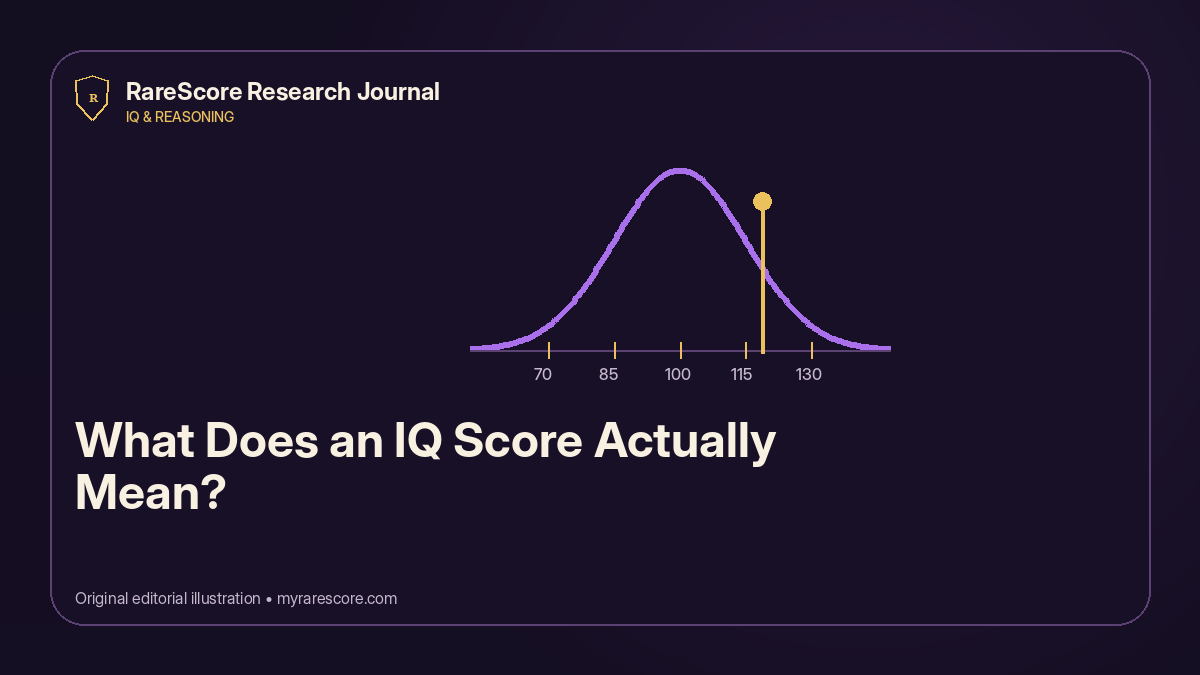
An IQ score is designed to place performance on a set of reasoning tasks relative to a reference group. The number is not a direct measurement of a physical quantity such as height. It is a standardized estimate produced from answers to selected tasks, scoring rules, and a particular norming sample.
Most modern IQ scales are centered near 100. Scores above or below that center represent distance from the average in the reference group. The exact meaning depends on the test, the age group, the quality of the norms, and whether the test was administered under controlled conditions.
Percentile is usually easier to understand than the raw number
A percentile answers a simple question: what proportion of the reference group scored below this result? A score around the center corresponds to roughly the 50th percentile. A higher score may correspond to a much higher percentile because the distribution is not linear in everyday language.
Percentiles do not mean that a person is “better than” that percentage of people in every form of intelligence. They refer only to performance on the abilities measured by that test under those conditions.
What IQ-style tests tend to measure
Well-constructed IQ tests usually sample several kinds of reasoning instead of relying on one puzzle type. Common areas include verbal reasoning, pattern recognition, working memory, quantitative reasoning, visual-spatial reasoning, and processing speed.
A person can have an uneven profile. Someone may be exceptionally strong in pattern discovery but slower on timed tasks. Another person may reason verbally at a high level while finding spatial rotation difficult. A single total score compresses those differences, which is why a dimension breakdown can be more useful than the headline number.
- Deduction: drawing conclusions that actually follow from the evidence
- Pattern reasoning: identifying rules across changing information
- Spatial reasoning: mentally rotating, assembling, or comparing shapes
- Quantitative reasoning: understanding numerical relationships
- Attention and working memory: holding and manipulating information
What an IQ score does not fully measure
IQ scores do not fully capture creativity, practical judgment, emotional understanding, discipline, wisdom, curiosity, moral character, social skill, or the ability to sustain effort over years. These qualities can strongly influence education, work, relationships, and life outcomes.
The score also does not explain why a person performed as they did. Sleep, anxiety, language familiarity, disability, motivation, cultural experience, and testing conditions can all affect performance.
How to interpret an online IQ result
An online IQ-style test can be useful as a challenging snapshot of reasoning, but it should not be presented as equivalent to a professionally administered and normed assessment. The safest wording is an estimate based on the site’s scoring model.
Look for transparency: the number of questions, the dimensions tested, the scoring approach, and a clear statement of limitations. Avoid sites that promise clinical certainty from a handful of easy puzzles.
The most useful question is not “Is this my intelligence?”
A better question is: what did the result reveal about the way I approached unfamiliar problems? Did you rush toward the first plausible answer? Did you overthink simple patterns? Were you strong when the rule was visual but weaker when language carried the logic?
Use the result as feedback. A score can start an investigation, but it should not end one.
Why the same person can receive different scores
No test score is perfectly fixed. A person can perform differently across days because attention, fatigue, stress, familiarity with the format, and ordinary measurement error change the result. Professional reports often interpret score ranges and confidence intervals rather than treating one observed number as exact.
Practice can also matter. Learning the structure of matrix problems or common verbal analogies may improve performance without changing every ability that people associate with intelligence. That is one reason repeat results should be compared carefully.
What to do after receiving a score
Begin with the breakdown. Identify the problem types that felt natural, the ones that consumed time, and the answers that were lost to assumptions rather than lack of knowledge. That information is more actionable than celebrating or worrying about the headline number.
When a high-stakes decision depends on cognitive assessment, an online result is not enough. A qualified professional can select an appropriate standardized instrument, control the testing conditions, interpret uneven subscale patterns, and consider factors that the website cannot observe.
- Review explanations before retaking the same questions
- Compare strengths across reasoning categories
- Treat small score changes as normal variation
- Seek professional assessment only when the decision requires it
Common questions
Is 100 a bad IQ score? No. On scales centered at 100, that result is near the reference average. The meaning still depends on the test, comparison group, and uncertainty around the observed score.
Can intelligence change? Skills, knowledge, strategies, health, education, and practice can change performance. A standardized score is a measurement at a time, not a fixed sentence about future capability.
Should a person share the score? That is a personal choice. Scores can be misunderstood when the audience ignores the test limits or treats one number as a complete hierarchy. Share the breakdown and methodology when context matters.
A worked interpretation: the same total, different profiles
Imagine two people who both receive an IQ-style score of 115. The first performs consistently across verbal, spatial, quantitative, and working-memory items. The second performs exceptionally on pattern and verbal problems but loses substantial ground on timed attention tasks. The total is identical, yet the practical interpretation is not. The first profile suggests broad consistency; the second suggests a sharper set of strengths combined with a condition that deserves investigation—possibly speed, fatigue, anxiety, unfamiliarity with the interface, or a genuine difference among abilities.
Now add uncertainty. If the score estimate has a confidence band of several points, 112 and 118 should not be treated as different ranks of person. The useful questions are narrower: which problem structures were handled well, which errors repeated, and how stable was performance across categories? A result becomes informative when it directs attention toward patterns that can be checked again, not when it turns a small numerical difference into a permanent identity.
Use this checklist
- Identify the exact test version and reference group.
- Read the percentile and confidence range alongside the score.
- Compare category scores before interpreting the total.
- Note timing, language, fatigue, device, and testing conditions.
- Use professional assessment for high-stakes conclusions.
What the evidence supports
The best interpretation is proportionate. A score can summarize performance efficiently and still leave important questions unanswered. Treat the number as a coordinate within a measurement system, then examine the profile, the uncertainty, and the intended use. That approach protects both sides of the truth: cognitive tests can provide meaningful information, and no single score is entitled to become a complete theory of a person.
About the RareScore Research Desk
This guide was reviewed for claim strength, source quality, originality, and practical usefulness. The Research Desk is an editorial function, not a licensed clinical service. See the editorial standards and writing-process disclosure.