Self-awareness • 6 min read • By RareScore Research Desk • Published 2026-10-04 • Updated 2026-10-04
EQ vs IQ: What Each Measures, Where They Overlap, and Why Both Matter
EQ vs IQ without the clichés: how abstract reasoning and emotional intelligence are measured, what each actually predicts at work and in relationships, and how to explore both.
What to know before reading further
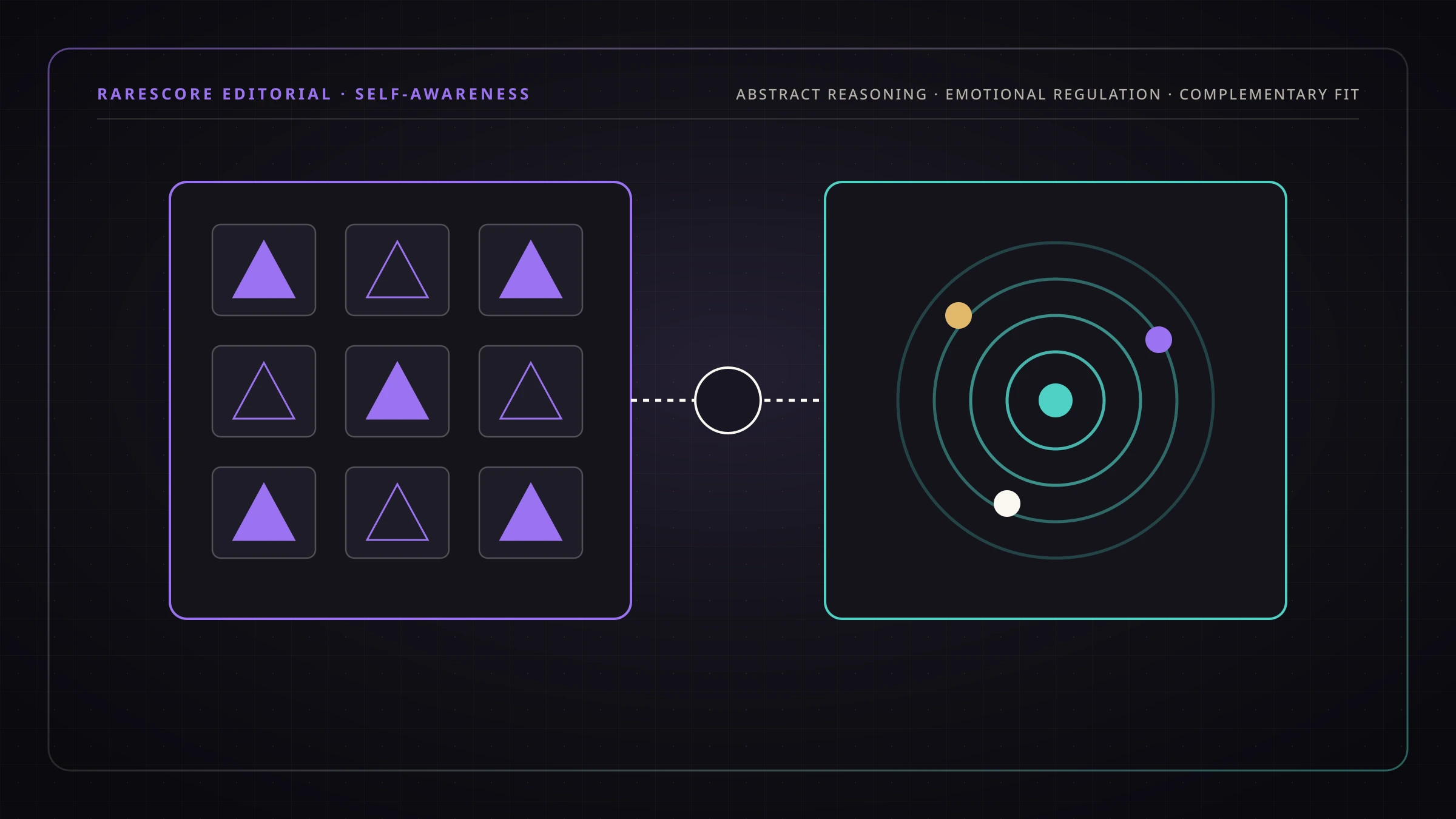
- IQ measures abstract problem-solving—pattern, logic, quantitative, verbal, and spatial reasoning—while EQ examines how people perceive, interpret, and regulate emotion in themselves and others.
- In psychological testing, IQ relies on objective right-or-wrong performance tasks, whereas EQ is split between ability-based situational judgment tests and trait-based self-report questionnaires.
- Viral claims that "EQ accounts for 80% of success" are unsupported; research shows general cognitive ability strongly predicts training speed and complex task performance, while EQ and personality add real value in leadership, teamwork, and conflict regulation.
- The most useful self-assessment looks at cognitive reasoning, emotional skills, and personality traits together rather than forcing a false choice between them.
This guide answers: Compare emotional intelligence (EQ) and cognitive intelligence (IQ), understand how each is measured in psychology, and see what each predicts in work and relationships.
Moving past the pop-psychology rivalry
Most articles on EQ vs IQ set up a fake contest: cold book smarts in one corner, warm people skills in the other, followed by a slogan that one of them explains almost all success. Real psychological research is much more interesting—and much more useful—than that.
IQ and EQ do not compete to measure the same thing. They describe different kinds of performance, rely on different test designs, and fail in different ways when you over-trust a single number. Understanding how each construct is built prevents both over-claiming from an online EQ score and assuming a high IQ score guarantees sound judgment around people.
What IQ measures vs what EQ measures
IQ (intelligence quotient) is a standardized summary of performance on cognitive tasks: spotting abstract rules in patterns, reasoning through logical constraints, manipulating quantities, understanding verbal relationships, and rotating shapes mentally. For how those tasks combine into a scaled score and percentile, see What Does an IQ Score Mean?.
EQ (emotional intelligence or emotional quotient) refers to how accurately a person perceives emotional signals, understands how emotions shift thoughts and behavior, regulates their own emotional reactions under stress, and navigates interpersonal tension. Psychologists Peter Salovey and John Mayer originally framed emotional intelligence around four branches: perceiving emotions, using emotions to facilitate thought, understanding emotional transitions, and managing emotions effectively.
How they are tested (and why EQ is harder to score cleanly)
The sharpest technical difference between IQ and EQ lies in how items are scored:
- Cognitive (IQ) items have objective, verifiable keys. A matrix completion, deductive syllogism, or number series has one defensible right answer regardless of how the examinee wants to appear.
- Ability EQ tests use situational problems—such as identifying subtle facial expressions, predicting how resentment or relief will evolve in a scenario, or ranking which response best de-escalates a conflict—scored against expert or consensus criteria.
- Trait EQ questionnaires ask for self-ratings ("I stay calm when criticized," "I quickly notice when a colleague shuts down"). These capture typical habits, but they overlap heavily with the Big Five personality traits—especially emotional stability, extraversion, and agreeableness—and are vulnerable to socially desirable answering.
Because of that split, two tests both labeled "EQ test" can measure very different constructs. For how to interpret a number on an emotional intelligence scale, read What Is a Good EQ Score?.
What each predicts at work, in learning, and in relationships
Decades of meta-analyses in industrial-organizational and educational psychology give a balanced picture that cuts through viral percentages:
- Learning speed and technical complexity: IQ and general cognitive ability remain among the strongest single predictors of how quickly someone acquires complex new rules, handles information-dense coursework, and troubleshoots novel analytical problems.
- Teamwork, service, and leadership climate: Once baseline technical competence is met, emotional regulation, active listening, and interpersonal perception explain meaningful variance in how effectively someone coaches others, handles feedback, and repairs trust after conflict.
- Decision quality under pressure: High cognitive ability helps you model options, while emotional regulation keeps stress or ego threat from hijacking that model in real time; see decision-making styles under pressure.
- Career fit: Roles differ in their mix of solitary analytical load and continuous human negotiation. Matching both dimensions beats chasing a single high score; see how to choose a career that fits.
Why "EQ matters more than IQ" is too simple
You have probably seen posters claiming that "EQ is responsible for 80% or 90% of career success." When researchers traced those numbers back to their sources, they found no empirical study supporting a fixed 80/20 split. Here is why the slogan breaks down:
- Range restriction in selective fields: Among senior surgeons, engineers, or attorneys, almost everyone has already cleared a high cognitive and educational threshold. Within that pre-selected group, differences in composure, empathy, and communication stand out sharply—not because cognitive ability stopped mattering, but because the floor is already high.
- Construct overlap: Broad "EQ" models often bundle conscientiousness, optimism, grit, and social warmth together with emotional perception. When a broad questionnaire predicts job performance, much of that prediction comes from well-known Big Five personality traits rather than a separate emotional quotient.
- Context dependence: An air-traffic anomaly, a statistical model bug, and a grieving direct report call for different blends of analytical precision and emotional attunement.
How to explore both on RareScore
Instead of treating EQ and IQ as rivals, use structured tools to inspect each angle separately:
- To test abstract reasoning across pattern, logic, numerical, verbal, and spatial problems, take the free RareScore IQ test.
- To explore how your emotional regulation, empathy, and interpersonal tendencies show up alongside core traits, take the free personality test or browse all assessments on /tests.
Every RareScore assessment shows its domain breakdown and explains its scoring boundaries in our methodology.
Frequently asked questions
Which is more important, EQ or IQ?
Neither wins across the board. Cognitive reasoning (IQ) strongly shapes how fast you learn complex systems and solve abstract technical problems, while emotional intelligence (EQ) and personality traits strongly shape how you manage stress, conflict, and collaboration. Most demanding roles and relationships require both.
Can you have a high IQ and a low EQ?
Yes. Abstract reasoning ability and emotional regulation are only modestly correlated. Someone can solve complex logical or quantitative problems quickly while struggling to read unspoken tension or manage frustration during interpersonal conflict—and vice versa.
Can you improve EQ more easily than IQ?
Your baseline temperament has stable components, but specific emotional and interpersonal habits—such as pausing before reacting, naming emotions accurately, and checking assumptions in conversation—are directly trainable skills. Cognitive practice mainly sharpens domain knowledge and reasoning habits rather than shifting general intelligence dramatically.
The technical lead promotion gap
Consider an analytics engineer who consistently solves the hardest data-pipeline failures on the team. On cognitive tasks involving formal logic, pattern detection, and quantitative modeling, their performance sits near the top of the department. When promoted to lead a cross-functional squad, however, the primary bottleneck shifts from debugging SQL and distributed queues to negotiating scope tradeoffs with anxious stakeholders and giving corrective feedback without triggering defensiveness.
If that lead treats management purely as an optimization puzzle—sending terse corrections in public channels and dismissing emotional friction as irrational—project velocity drops even though their technical architecture is sound. Conversely, a manager with warm empathy who cannot follow the technical constraints of the system may validate everyone's feelings while committing the team to an impossible delivery schedule. Seeing EQ and IQ as complementary instruments explains why the role requires both analytical clarity and emotional regulation.
Use this checklist
- Have you separated objective cognitive reasoning tasks (IQ) from emotional perception and regulation (EQ)?
- When reading an EQ result, did you check whether the test used situational ability items or self-report trait questions?
- Did you account for overlap between self-reported EQ and Big Five traits like emotional stability and agreeableness?
- Have you matched the mix of analytical load and interpersonal demand to the specific role or goal in front of you?
- Are you focusing on concrete behavioral habits you can practice rather than treating either score as fixed destiny?
What the evidence supports
The real lesson of EQ vs IQ is not that one dethrones the other; it is that human judgment relies on both clear reasoning and steady emotional regulation. Knowing how you process abstract rules and how you respond when interpersonal stakes rise gives you a far more honest map than any single number. Explore both sides directly with RareScore's free IQ test and free personality test.
About the RareScore Research Desk
This guide was reviewed for claim strength, source quality, originality, and practical usefulness. The Research Desk is an editorial function, not a licensed clinical service. See the editorial standards and writing-process disclosure.
Sources and further reading
- Salovey, P., & Mayer, J. D. (1990). Emotional Intelligence — Imagination, Cognition and Personality
- Mayer, J. D., Roberts, R. D., & Barsade, S. G. (2008). Human Abilities: Emotional Intelligence — Annual Review of Psychology
- Joseph, D. L., & Newman, D. A. (2010). Emotional Intelligence: An Integrative Meta-Analysis and Cascading Model — Journal of Applied Psychology
- Schmidt, F. L., & Hunter, J. E. (1998). The Validity and Utility of Selection Methods in Personnel Psychology — Psychological Bulletin
- APA Dictionary of Psychology — Emotional Intelligence