Personality science • 5 min read • By RareScore Research Desk
The Big Five Personality Traits Explained Without the Jargon
Understand openness, conscientiousness, extraversion, agreeableness, and negative emotionality as continuous traits—not rigid personality types.
What to know before reading further
- The Big Five are broad dimensions, not five personality types.
- Each dimension contains narrower facets that can differ substantially within the same person.
- High and low scores can each carry advantages and costs depending on the situation.
- Trait scores summarize tendencies across time; they do not dictate every action.
This guide answers: Understand the five broad trait dimensions, their facets, and why scores are continuous rather than fixed types.
The Big Five is descriptive compression
The Big Five is powerful because it compresses thousands of trait words and behavioral tendencies into a smaller set of broad dimensions. Compression is not explanation. A high conscientiousness score summarizes patterns such as order, persistence, caution, and goal control; it does not by itself tell us why those patterns developed or which one will dominate in a specific situation.
This distinction protects the model from being asked to do too much. The Big Five can organize description, support research, and improve comparison across people. Motives, beliefs, relationships, incentives, and context are still needed to explain behavior. A profile is a map of recurring terrain, not the engine that moves through it.
The Big Five describes dimensions, not five kinds of people
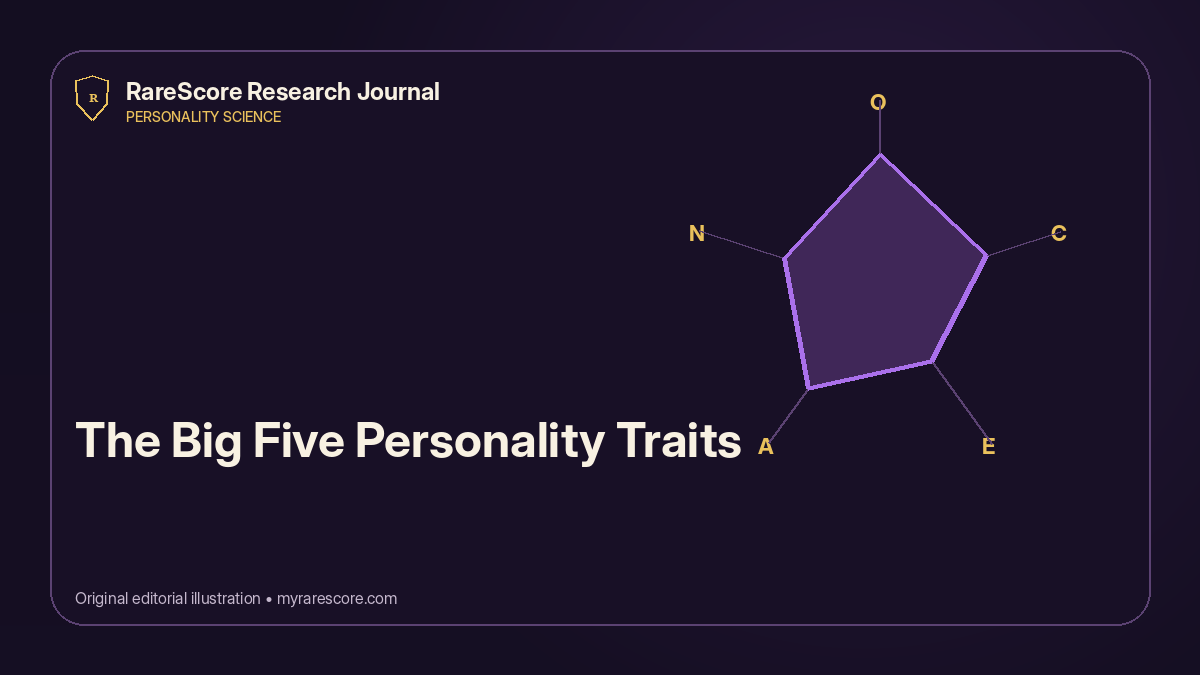
The Big Five model organizes personality differences into broad dimensions often called openness, conscientiousness, extraversion, agreeableness, and neuroticism or negative emotionality. Every person can be described along each dimension.
This is different from a type system that places people into one box. A person may be highly conscientious, moderately extraverted, low in agreeableness, and high in openness at the same time. The combination matters.
Openness: curiosity, imagination, and preference for complexity
People higher in openness often enjoy new ideas, art, imagination, intellectual exploration, or unconventional perspectives. Lower openness can reflect a preference for familiarity, practicality, tradition, or concrete information.
Neither end is automatically better. High openness can support creativity but also distract from execution. Lower openness can support consistency but sometimes resist useful change.
Conscientiousness: organization, persistence, and control of action
Conscientiousness includes planning, reliability, order, persistence, and the ability to delay immediate impulses for longer-term goals. It is not the same as intelligence or moral goodness.
High conscientiousness can support achievement and dependability, while excessive control may become rigidity or perfectionism. Lower conscientiousness can support spontaneity but create problems with follow-through.
Extraversion: social energy and reward sensitivity
Extraversion includes sociability, assertiveness, positive energy, and responsiveness to reward. Introversion does not mean shyness or dislike of people; it often means lower need for stimulation and more preference for quiet or selective interaction.
Context matters. Someone can be reserved with strangers and highly expressive with close friends, or socially confident while still needing substantial time alone.
Agreeableness: cooperation, compassion, and conflict style
Agreeableness concerns empathy, patience, trust, cooperation, and willingness to maintain harmony. Lower agreeableness can include skepticism, competitiveness, bluntness, or willingness to confront.
High agreeableness may support relationships but make boundaries harder. Lower agreeableness can protect independence and directness but increase conflict.
Negative emotionality: sensitivity to threat and distress
This dimension describes how readily a person experiences anxiety, worry, frustration, sadness, or emotional reactivity. Lower scores often reflect calmness and resilience, but can also mean underreacting to important signals.
Higher emotional sensitivity is not simply weakness. It can support vigilance, empathy, and preparation while also increasing stress or rumination.
How to use the model responsibly
Broad traits summarize tendencies across time, but they do not dictate behavior in every situation. Roles, culture, habits, relationships, and incentives can change what a trait looks like.
Use a profile to notice patterns and tradeoffs. Avoid turning a score into destiny or assuming that one dimension explains every decision.
Each broad trait contains narrower facets
Two people can receive similar broad scores for different reasons. High extraversion may come mainly from assertiveness in one person and social enthusiasm in another. Conscientiousness can reflect order, persistence, caution, or achievement striving.
Facet-level interpretation prevents the broad label from becoming vague. It also explains why people with similar totals can behave differently in specific settings.
Traits can change gradually without becoming meaningless
Personality shows continuity, but habits, roles, relationships, culture, and major life experiences can shift average patterns. Change is usually gradual rather than a complete replacement of identity.
A test result is therefore a current map, not a sentence. Repeating an assessment after meaningful time and experience can reveal movement, especially when the same measurement method is used.
Why facets prevent caricatures
Two people can receive similar extraversion scores for different reasons. One may be highly assertive but prefer limited social contact. Another may seek frequent interaction but avoid leadership. A broad total compresses assertiveness, sociability, positive emotion, and activity into one dimension; the facets recover the shape that the total hides.
The same is true for conscientiousness. Orderliness and industriousness often correlate, but a person can maintain an immaculate system while procrastinating on difficult work, or work relentlessly in a chaotic environment. Calling both simply “high” or “low” loses the tradeoff that matters.
Use the Big Five in layers: broad traits for orientation, facets for precision, and situations for prediction. The model becomes less memorable than a five-type quiz, but far more faithful to how personality actually varies.
Use this checklist
- Read broad traits as continua rather than types.
- Inspect facets when a total seems misleading.
- Consider the advantage and cost of each extreme.
- Use situations and motives to explain behavior.
- Avoid treating a descriptive model as destiny.
What the evidence supports
The Big Five is most useful when it prevents caricature rather than creating it. Broad dimensions make comparison possible, facets restore shape, and situations explain variation. Used together, they can describe recurring tendencies without denying choice or context. Used as five rigid boxes, the model loses the very continuity and nuance that made it scientifically valuable. The five domains are also not five destinies. A trait describes a probability distribution across situations, not an instruction that behavior must follow. Skills, roles, incentives, culture, and deliberate habits can change what a person does even when broad tendencies remain recognizable. The most useful profile therefore connects a trait to observable choices and context instead of treating a percentile as a permanent identity label.
About the RareScore Research Desk
This guide was reviewed for claim strength, source quality, originality, and practical usefulness. The Research Desk is an editorial function, not a licensed clinical service. See the editorial standards and writing-process disclosure.