Self-awareness • 7 min read • By RareScore Research Desk • Published 2026-10-05 • Updated 2026-10-05
What Is a Good EQ Score? Why There Isn’t One Universal Scale
Unlike IQ, emotional intelligence has no single universal scale across every publisher. Learn how ability and trait EQ scores work, what percentiles mean, and how to read your result.
What to know before reading further
- Unlike clinical IQ tests, emotional intelligence assessments do not share one universal numbering scale across every publisher.
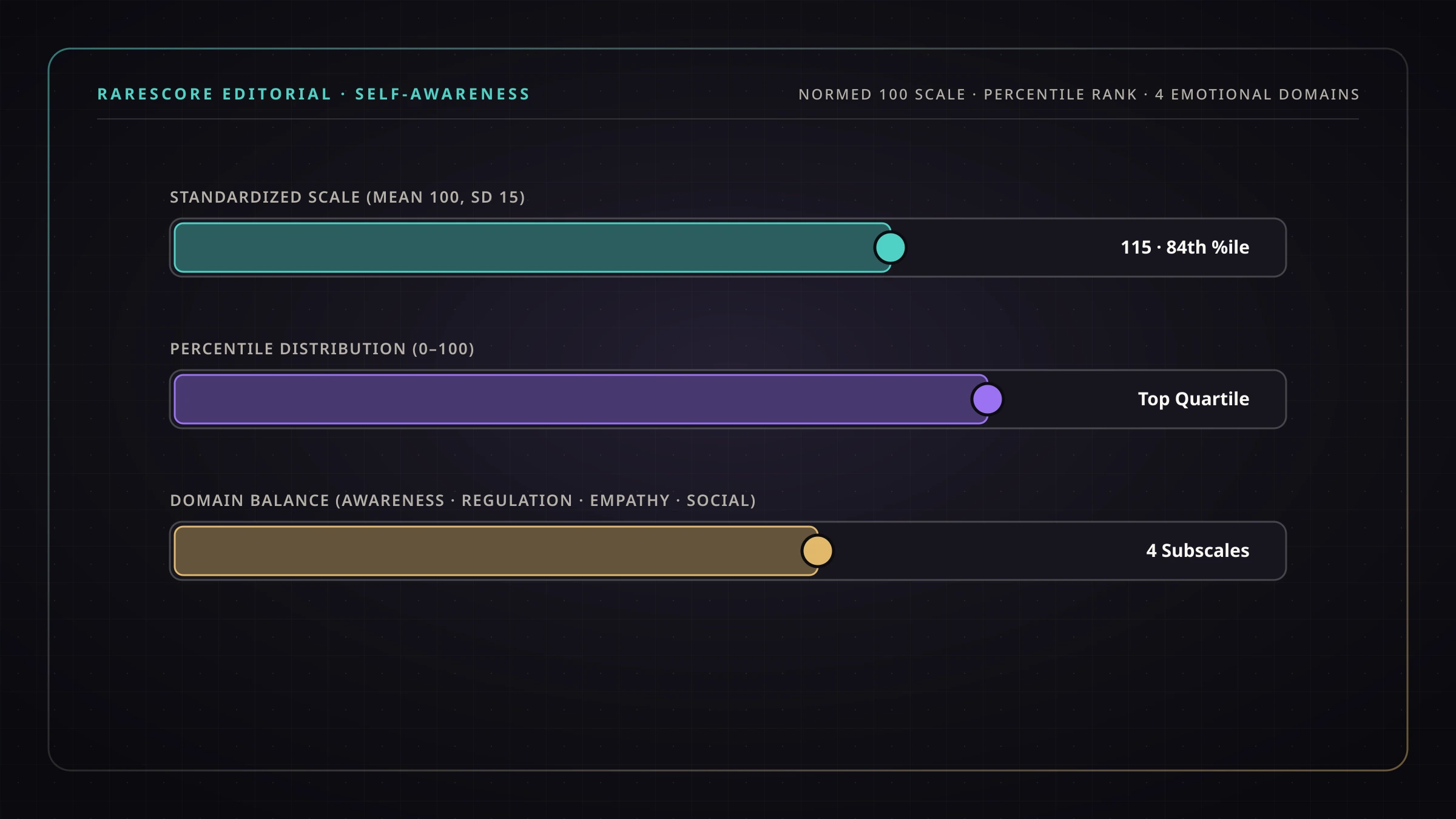
- Standardized ability and workplace EQ instruments (such as the MSCEIT or EQ-i 2.0) often use an IQ-like scale centered at 100 with a standard deviation of 15, where 90–109 is average and 115+ is above average.
- Many consumer and online EQ quizzes score on 0–100 percentage scales, 1–5 Likert averages, or raw point totals, making raw numbers incomparable without a percentile rank.
- A meaningful EQ result separates self-awareness, emotional regulation, empathy, and social navigation rather than reducing interpersonal skill to one badge.
This guide answers: Understand why EQ scores vary by test format, how standardized 100-mean scales and 0-100 percentage quizzes differ, and what a high or low EQ score actually indicates.
Why a raw EQ number means nothing without its scale
When people ask "what is a good EQ score?", they usually expect a clean universal cutoff like 120 or 130 on an IQ scale. Here is the catch: emotional intelligence tests do not share one standard numbering system. A score of 78 can be an above-average percentage on a consumer quiz, a low standard score on a 100-centered clinical instrument, or a high raw total on a 90-point inventory.
Before you decide whether your EQ score is high, average, or low, you have to identify which scoring model produced it. For how emotional intelligence differs from cognitive testing in the first place, read EQ vs IQ: What Each Measures and Why Both Matter.
Why EQ doesn't have one universal scale like IQ
Cognitive intelligence tests converged decades ago on a shared convention: a mean of 100 and a standard deviation of 15 within an age-normed reference sample. Emotional intelligence is a younger and more divided field, and tests fall into three different families:
- Ability-based EQ assessments (such as the Mayer-Salovey-Caruso Emotional Intelligence Test, or MSCEIT): These present emotional problems—reading expressions, understanding emotional blends, and evaluating regulation strategies—and score answers on an IQ-style scale with a mean of 100 and a standard deviation of 15.
- Standardized trait and workplace inventories (such as the EQ-i 2.0): These use self-report or 360-degree rater items across composite scales and also convert raw totals to a normed standard score centered at 100 (SD 15).
- Consumer and online EQ quizzes: These typically report a percentage from 0 to 100, a Likert mean from 1.0 to 5.0, or a sum of item points (such as 50 to 200) without a formal population norm table.
Because all three formats call their output an "EQ score," comparing a raw number across two websites is like comparing Fahrenheit and Celsius without checking the unit label.
Typical bands on common EQ test formats
Once you check which scale your test uses, you can read the bands sensibly:
- On 100-mean, SD-15 standardized scales (MSCEIT, EQ-i 2.0, and similar normed instruments):
- Below 85: Lower than typical range (below roughly the 16th percentile); flags areas where reading or regulating emotional tension may feel effortful. - 90 to 109: Average range (roughly the 25th to 75th percentile), where half of the reference population lands. - 110 to 119: High average / competent range (roughly the 75th to 90th percentile). - 120 and above: Well-developed / very high range (top 10% and above, with 130+ sitting near the 98th percentile).
- On 0-to-100 percentage or profile scales (common in online self-assessments):
- The number usually reflects what proportion of maximum self-rated points you endorsed, not a population percentile. - Scores around 60–75 often represent moderate, balanced self-ratings, while 80+ indicates strong self-endorsed confidence across emotional domains.
For a deeper look at how self-report questionnaires behave and where their blind spots lie, see Are Personality Tests Accurate?.
The four domains behind a useful EQ score
Even on a well-normed instrument, a single overall EQ number hides the most actionable information. Most research-backed frameworks break emotional skill into four distinct components:
- Self-awareness (perceiving and naming your own state): noticing frustration, defensiveness, or fatigue early—before it leaks into tone or impulsive decisions.
- Self-regulation (managing your emotional response): tolerating discomfort, pausing before replying under provocation, and recovering composure after setbacks.
- Social perception and empathy (reading others accurately): picking up shifts in tone, hesitation, and unspoken context without projecting your own mood onto the room.
- Relationship navigation (handling tension and boundaries): giving candid feedback, repairing misunderstandings, and keeping clear boundaries without hostility; see trust, boundaries, and closeness.
Two people can post the exact same overall EQ score with opposite needs: one reads other people effortlessly (`high social perception`) but floods under criticism (`lower self-regulation`), while the other stays outwardly calm (`high regulation`) yet misses subtle signals that a teammate is overwhelmed (`lower social perception`).
Self-report blind spots (and when a "very high" score is a warning sign)
Self-report EQ tests carry an irony that ability tests avoid: rating your own emotional skill requires self-awareness. That creates two common distortions:
- Self-critical under-rating: Thoughtful, conscientious people who notice every awkward pause or flash of irritation often grade themselves harshly on Likert scales, landing in a modest range even when colleagues experience them as steady and empathetic.
- Overconfident inflation: Someone who rarely notices how their bluntness lands on others may strongly agree with statements like "I always read the room accurately," producing a near-perfect self-report score that clashes with real-world feedback.
- Overlapping personality traits: Much of a trait EQ score reflects Big Five personality dimensions like emotional stability and agreeableness rather than a standalone skill test.
If you want to pressure-test your own self-perception beyond a multiple-choice slider, pair your score with questions to ask yourself for self-awareness.
How to read your result on RareScore
When you review an emotional or interpersonal profile on RareScore:
- Look at the percentile and subscale balance first, not just the composite headline.
- Compare your highest and lowest domains to spot where stress is most likely to trip you up.
- Treat any self-assessment as a structured mirror for reflection—not a clinical verdict.
You can explore how your interpersonal style, emotional steadiness, and core traits fit together on RareScore's free personality test, browse all assessments on /tests, and review how scores are calculated in our methodology.
Frequently asked questions
What is considered a high EQ score?
On standardized assessments that use a mean of 100 and a standard deviation of 15, scores of 115 and above are considered above average (roughly the 84th percentile and up), and 120 to 130+ represents a very high range. On 0–100 consumer scales, check the percentile or domain breakdown rather than the raw number.
What is the average EQ score?
On normed clinical and organizational instruments (like the MSCEIT or EQ-i 2.0), the average score is set at 100, with most test-takers scoring between 90 and 109. On un-normed online quizzes, the average depends entirely on how many questions the quiz asks and how the point scale is built.
Can your EQ score change over time?
Yes. Unlike general cognitive speed, specific emotional habits—such as pausing before reacting under stress, checking assumptions in tense conversations, and naming emotions more precisely—can improve measurably with deliberate practice and honest feedback.
Why two "112" EQ profiles behave differently under conflict
Suppose two managers both receive an overall score of 112 on a 100-centered emotional intelligence inventory—putting both in the high-average range near the 79th percentile. Manager A scores 124 on interpersonal empathy and 96 on impulse regulation under stress. Manager B scores 98 on interpersonal empathy and 125 on emotional composure.
In calm one-on-one coaching sessions, Manager A shines: people feel heard immediately and open up about hidden blockers. During a high-stakes outage or deadline slip, however, Manager A's lower regulation score shows up as visible anxiety and sharp, reactive messages that rattle the team. Manager B has the opposite pattern: steady and unshakable during a crisis, yet slow to notice when a quiet team member is burning out during normal weeks. Reading the four domain scores tells each manager exactly what habit to practice; reading "112" alone hides both risks.
Use this checklist
- Did you check whether the test uses a normed 100-mean (SD 15) scale, a 0–100 percentage, or a raw point total?
- Have you looked at your percentile rank rather than treating the raw number like an IQ score?
- Did you compare your four domain scores (self-awareness, regulation, empathy, relationship navigation)?
- Did you ask whether self-critical grading or wishful self-rating could have tilted a self-report score?
- Have you chosen one concrete interpersonal or regulation habit to test in real conversations this week?
What the evidence supports
A good EQ score is not a universal badge number—it is a clear reading of how well you notice, regulate, and navigate emotion relative to the scale the test actually uses. Focus on the percentile rank and the gap between your strongest and weakest emotional domains, then test those insights against real feedback from the people around you. To map your own trait and interpersonal patterns, take RareScore's free personality test or explore all assessments on /tests.
About the RareScore Research Desk
This guide was reviewed for claim strength, source quality, originality, and practical usefulness. The Research Desk is an editorial function, not a licensed clinical service. See the editorial standards and writing-process disclosure.
Sources and further reading
- Mayer, J. D., Salovey, P., & Caruso, D. R. (2004). Emotional Intelligence: Theory, Findings, and Implications — Psychological Inquiry
- Brackett, M. A., Rivers, S. E., & Salovey, P. (2011). Emotional Intelligence: Implications for Personal, Social, Academic, and Workplace Success — Social and Personality Psychology Compass
- Petrides, K. V., Pita, R., & Kokkinaki, F. (2007). The Location of Trait Emotional Intelligence in Personality Factor Space — British Journal of Psychology
- APA Dictionary of Psychology — Emotional Intelligence
- AERA, APA, & NCME — Standards for Educational and Psychological Testing
Continue exploring
- EQ vs IQ: What Each Measures, Where They Overlap, and Why Both Matter
- Are Personality Tests Accurate? What Accuracy Really Means
- The Big Five Personality Traits Explained Without the Jargon
- 30 Questions to Ask Yourself for Real Self-Awareness
- Trust, Boundaries, and the Difference Between Privacy and Distance