Relationships • 5 min read • By RareScore Research Desk
Trust, Boundaries, and the Difference Between Privacy and Distance
Why some people need time before opening up, how boundaries protect closeness, and when privacy turns into avoidance.
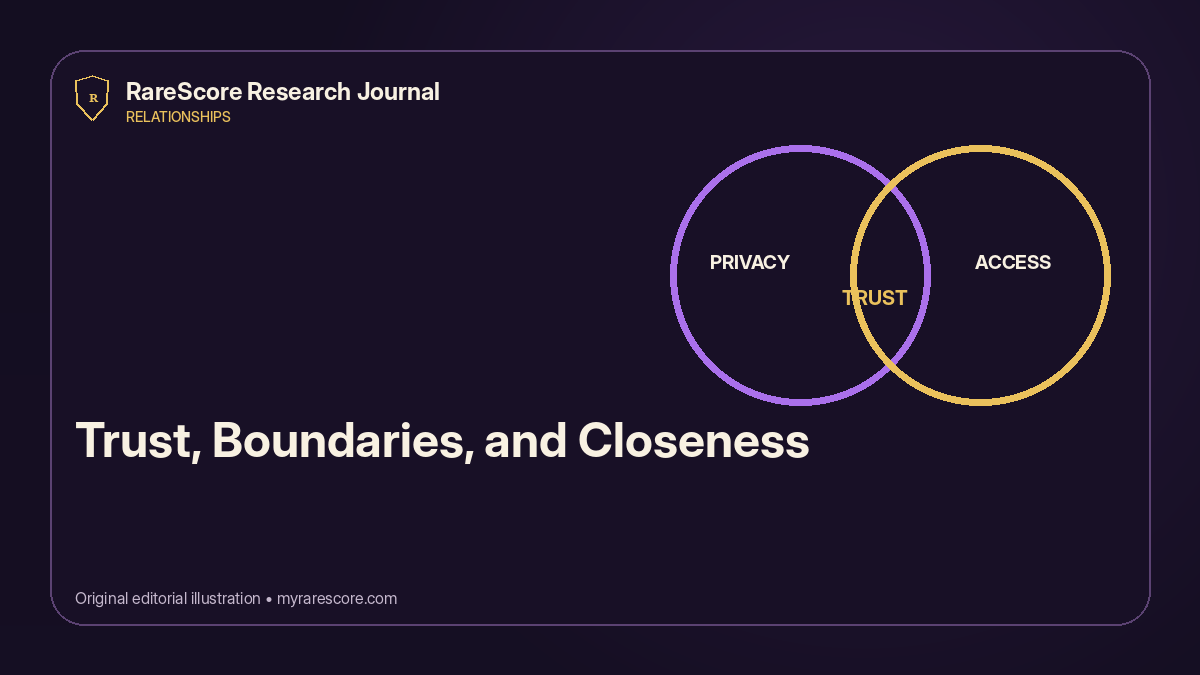
What to know before reading further
- Privacy protects chosen personal space; secrecy conceals information that materially changes the relationship.
- Disclosure builds closeness most reliably when the response is understanding and respectful.
- A boundary is not merely a demand placed on another person; it includes what you will do to protect your limit.
- Distance can be restorative, avoidant, strategic, or protective—the context determines the meaning.
This guide answers: Distinguish privacy, boundaries, avoidance, trust, and responsive intimacy in close relationships.
Trust is calibrated permission
Trust is often discussed as a feeling, but in relationships it also functions as a permission system. We permit another person to influence our plans, access private information, interpret our vulnerability, or rely on our commitments. Different permissions can be granted at different levels; trusting someone with emotion is not identical to trusting them with money, confidentiality, or decision authority.
This makes boundaries compatible with closeness. A boundary does not necessarily announce distrust; it specifies the conditions under which access remains safe and voluntary. Problems arise when one person treats total access as proof of love or when the other uses “privacy” to conceal information that changes the shared reality. The distinction is not the amount disclosed but the obligations created by the relationship.
Trust is partly a decision about access
Trust is not only a feeling that someone is good. It is a decision about what information, vulnerability, responsibility, or influence the person is allowed to hold.
Different people require different evidence. Some grant early trust and revise later. Others begin cautiously and expand access after consistency. Neither pattern is automatically healthier.
Privacy can protect identity
Privacy creates a space where thoughts can develop without immediate evaluation. It can reduce performance pressure and preserve autonomy inside close relationships.
The problem is not having a private interior life. The problem begins when privacy is used to prevent any possibility of being known, corrected, or affected.
A boundary describes your action
A boundary is clearer when it states what you will do rather than controlling another person. “If the conversation becomes insulting, I will leave” is different from “You are not allowed to be angry.”
Healthy boundaries make consequences predictable. They do not require the other person to agree that the boundary is fair.
Distance becomes avoidance when repair is indefinitely postponed
Taking space can prevent escalation. But an undefined silence transfers all uncertainty to the other person.
A specific pause—how long, what will happen next, and whether the relationship is still intact—preserves regulation without using uncertainty as punishment.
Trust rebuilds through behavior, not intensity
A powerful apology can matter, but trust usually returns through repeated evidence: honesty when dishonesty would be easier, reliability when it costs something, and respect for boundaries when no one is watching.
This is why forgiveness and restored access are different decisions. Anger may be released before risk has changed.
Closeness without self-erasure
The healthiest form of closeness allows two people to influence each other without requiring either person to disappear. Autonomy and belonging are not opposites when the relationship can tolerate honest difference.
A useful question is: can I say no, change my mind, or need time without the bond becoming a threat?
Trust can be calibrated instead of all-or-nothing
You can trust someone with punctuality but not confidential information, with practical help but not financial authority. Treating trust as one switch creates pressure either to disclose too much or to close access completely.
Calibrated trust names the domain, level of risk, evidence required, and consequence if the expectation is broken.
A boundary conversation that remains specific
Describe the behavior, its impact, and your next action. Avoid diagnosing the other person’s character when the immediate goal is clarity.
After stating the boundary, watch behavior. Repeated negotiation over whether you are allowed to have the boundary is different from a good-faith discussion about how to respect it.
- “When this happens…”
- “The impact on me is…”
- “What I need going forward is…”
- “If it continues, I will…”
- “We can revisit this after…”
Common questions
Can trust return after betrayal? Sometimes, but forgiveness, contact, and restored access are separate choices. Rebuilding usually requires time and repeated evidence.
Is needing privacy a sign of avoidance? Not by itself. Privacy becomes avoidance when it is used indefinitely to prevent every difficult conversation or reciprocal form of being known.
Can a boundary be unfair? Yes. People can call a demand a boundary. A useful test is whether it describes your own participation and consequence rather than controlling another person’s internal life.
A boundary becomes clearer when it includes a consequence
“Do not speak to me that way” expresses a preference. “If the conversation becomes insulting, I will pause it and return when we can discuss the issue without personal attacks” describes a boundary. The second statement identifies the condition, the protective action, and the route back to connection. It does not require control over the other person’s behavior.
Trust can be calibrated in the same way. After a breach of confidentiality, a person may restore emotional closeness before restoring access to sensitive information. After financial unreliability, companionship may continue while shared accounts do not. All-or-nothing language—complete trust or no relationship—often hides the fact that different permissions can recover at different rates.
The test of healthy distance is whether it serves repair and choice. Temporary space can prevent escalation and restore perspective. Indefinite silence that keeps the other person uncertain may function as avoidance or punishment. The behavior looks similar from the outside; the communicated purpose, duration, and return plan reveal the difference.
Use this checklist
- Specify the condition, protective action, and return path.
- Separate emotional trust from financial or informational access.
- Ask whether privacy protects choice or conceals shared reality.
- Rebuild permissions at different speeds after a breach.
- Communicate the purpose and duration of temporary distance.
What the evidence supports
Closeness becomes safer when access is explicit rather than assumed. People can choose different levels of disclosure, dependence, and shared decision authority without reducing the relationship to either total openness or emotional distance. The practical work is to make permissions understandable, repairable, and voluntary. Trust grows through repeated evidence that access will not be used carelessly. Healthy closeness is also reciprocal rather than perfectly symmetrical. Two people may contribute different forms of care, disclosure, time, or practical help, but each should be able to influence the terms of the relationship. A boundary becomes more credible when it is specific, behavior-linked, and paired with a consequence the speaker can actually carry out—not when it is used as a threat or a test of devotion.
About the RareScore Research Desk
This guide was reviewed for claim strength, source quality, originality, and practical usefulness. The Research Desk is an editorial function, not a licensed clinical service. See the editorial standards and writing-process disclosure.