Self-discovery • 5 min read • By RareScore Research Desk
40 Questions to Ask Yourself for Real Self-Awareness
Use thoughtful self-awareness questions about motives, boundaries, identity, pressure, relationships, ambition, and the gap between intentions and behavior.
What to know before reading further
- The best reflection questions begin with observable events rather than abstract self-judgments.
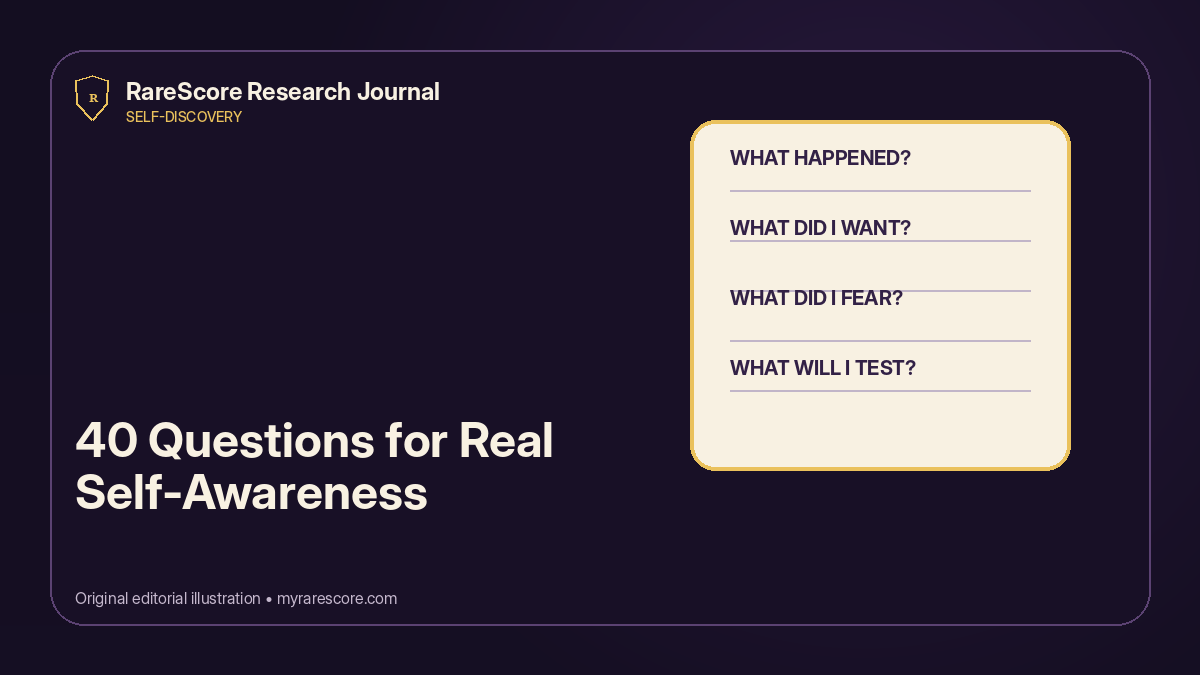
- Separate what happened, what you wanted, what you feared, and what you did.
- Look for repeated triggers and tradeoffs instead of one dramatic memory.
- End reflection with a testable next action, not only a description.
This guide answers: Use specific reflection questions to examine patterns, motives, boundaries, decisions, and contradictions.
Introspection can manufacture a convincing story
Looking inward feels like direct access to the truth, but reflection is also reconstruction. We infer motives after the fact, select memories that fit the current identity, and confuse a polished explanation with an accurate one. Self-awareness improves when introspection is paired with behavioral evidence.
Instead of asking “Am I a loyal person?” ask what you did the last three times loyalty carried a cost, what competing value was present, and what condition would have changed your choice. The question becomes harder to answer elegantly and easier to answer honestly.
Good self-awareness questions focus on patterns, not slogans
“Who am I?” is too broad to answer in one sentence. Better questions connect a specific situation, motive, choice, and consequence. They ask what you repeatedly protect, avoid, seek, or rationalize.
Write quickly at first, then review your answer for examples. A response becomes more useful when it points to actual behavior rather than an ideal self-description.
Questions about motives
Motives are often mixed. You can help someone because you care and because you want to be needed. You can pursue success because the work matters and because recognition feels protective.
Use these prompts to identify the force beneath the visible action.
- What do I want people to notice without asking them to notice it?
- Which loss scares me more: control, belonging, status, security, or freedom?
- When I say “I do not care,” what am I protecting?
- What kind of praise affects me more than I admit?
- Which responsibility gives me meaning, and which only gives me guilt?
- When do I confuse being needed with being loved?
Questions about who appears under pressure
Stress can narrow attention and amplify protective habits. Some people become controlling, some withdraw, some seek reassurance, and others act before uncertainty can grow.
The goal is not to judge the response. It is to identify the trigger and the cost.
- What behavior appears first when I feel disrespected?
- Do I become quieter, louder, faster, or more rigid when uncertain?
- Which problem makes me abandon my usual values?
- What am I trying to prevent when I overthink?
- What does my body notice before my mind admits I am stressed?
- Whom do I become most unfair to when I feel threatened?
Questions about trust and relationships
Relationship patterns are easier to see when you compare what you ask from others with what you allow yourself to do.
Answer with the most recent real example you can remember.
- What must someone do before I stop giving them the benefit of the doubt?
- Do I want an apology, changed behavior, public repair, or restored control?
- Which boundary do I explain repeatedly instead of enforcing?
- What do I forgive in people I admire but condemn in people I dislike?
- Do I reveal needs directly or test whether people notice them?
- What makes closeness feel unsafe?
Questions about identity and ambition
Identity becomes clearer when you examine the conflict between who you are, who you present, and who you are trying to become.
Notice which answers are about your own values and which depend on an audience.
- Which success would impress others but disappoint me privately?
- What would I still pursue if no one could ever know?
- Which past version of me am I still arguing against?
- What quality do I protect even when it costs me opportunity?
- Which weakness do I disguise as a principle?
- What would change if I stopped needing to appear consistent?
Turn reflection into an experiment
Choose one answer that describes a repeated problem. Write a small prediction about the next time the pattern appears, then select a different response you can test.
Self-awareness improves when reflection produces observable experiments. The goal is not endless analysis; it is more choice at the moment a familiar pattern begins.
Questions about work, ambition, and responsibility
Work reveals what you do when values meet deadlines, status, money, and accountability. The most useful questions compare what you say matters with what receives your time.
- Which task do I delay because failure would threaten my identity?
- Do I want leadership, recognition, control, or the ability to improve the outcome?
- Where do I confuse perfection with responsibility?
- Which promise do I keep only because I fear disappointing people?
- What problem am I uniquely willing to tolerate long enough to solve?
- When does competition make me better, and when does it make me smaller?
How to review your answers without overinterpreting them
Underline repeated words and motives. Then search for counterexamples. If you describe yourself as conflict-avoidant, identify situations where you confronted someone quickly and ask what was different.
Return to the questions after several weeks. The answers that remain stable may reflect enduring priorities, while the answers that change may reveal context, mood, or growth.
Convert reflection into an evidence table
Choose one recurring situation—criticism, procrastination, conflict, spending, leadership, or closeness. Create five columns: what happened, what I noticed, what I wanted, what I did, and what followed. Fill the table with three separate examples before drawing a conclusion. This reduces the temptation to build an identity from the most dramatic memory.
Then add a counterexample. When did you respond differently, and what changed? Perhaps criticism felt manageable in private but intolerable in front of others. Perhaps procrastination disappeared when another person depended on the work. The counterexample identifies the context that activates or suppresses the pattern.
Finish with a small prediction: “If I ask for clarification before defending myself, the conversation will remain more specific.” Test it once. Self-awareness becomes useful when it improves the next observation, not only the elegance of the story.
Use this checklist
- Start with three specific events, not one identity statement.
- Separate observation, motive, fear, behavior, and consequence.
- Find a counterexample and identify what changed.
- Ask someone trustworthy for behavioral evidence.
- End with a small prediction you can test.
What the evidence supports
Self-awareness should make future behavior easier to observe, not merely produce a compelling autobiography. Specific examples, counterexamples, outside feedback, and small predictions protect reflection from becoming self-confirming. The goal is a model that can be corrected by experience. A story that explains everything after the fact may feel deep while teaching very little.
About the RareScore Research Desk
This guide was reviewed for claim strength, source quality, originality, and practical usefulness. The Research Desk is an editorial function, not a licensed clinical service. See the editorial standards and writing-process disclosure.