IQ & reasoning • 5 min read • By RareScore Research Desk
How to Improve Logical Reasoning Without Memorizing Tricks
A practical training system for deduction, patterns, probability, spatial reasoning, and best-answer questions.
What to know before reading further
- Improvement comes from diagnosing error types, not memorizing isolated puzzle tricks.
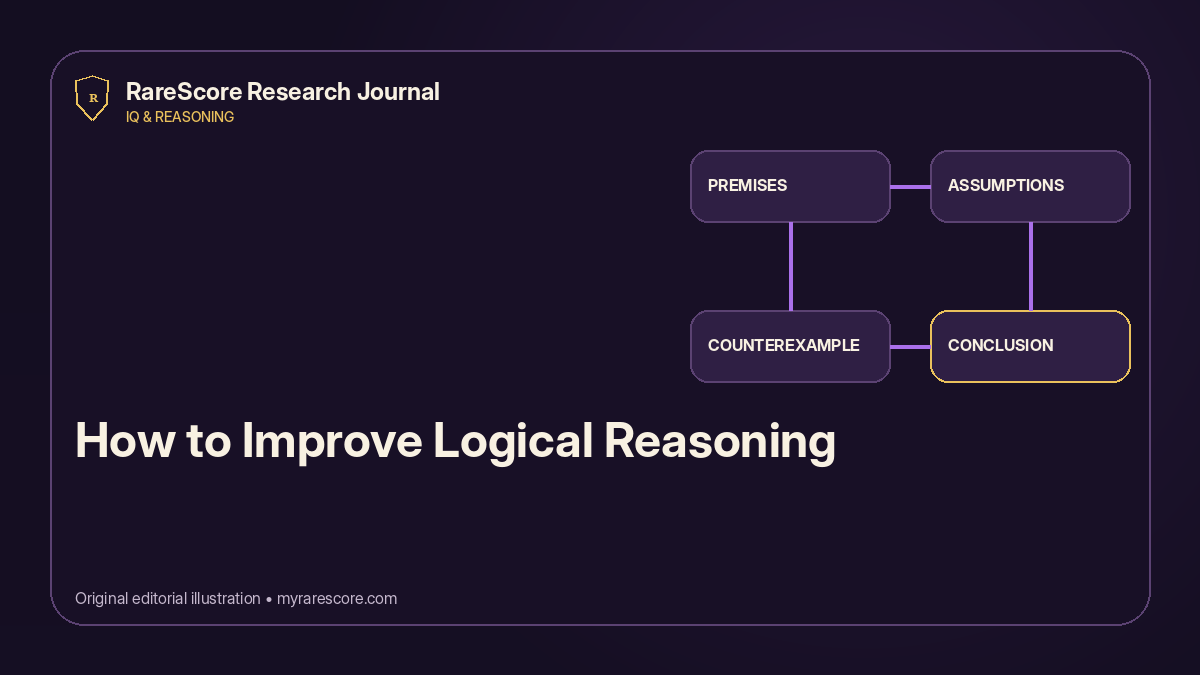
- Translate claims into premises and test whether the conclusion must follow.
- Search deliberately for counterexamples before accepting an attractive answer.
- Practice should vary the surface form while preserving the same underlying reasoning structure.
This guide answers: Build a repeatable method for deduction, conditional reasoning, probability, and error review.
Most reasoning errors begin before the reasoning
People often review a missed question by studying the correct answer. That is too late. The decisive error may have occurred when the problem was represented: a conditional statement was reversed, a probability was treated as a percentage of the wrong group, or an ambiguous word was assigned the convenient meaning. Once the wrong model is built, careful reasoning can produce a confidently wrong conclusion.
Effective practice therefore reconstructs the error chain. What information was noticed first? What assumption entered without permission? What alternative model would have made another answer plausible? Training at that level transfers across question formats because it improves the construction of the problem, not merely recognition of a familiar trick.
Logical reasoning is a set of skills, not one talent
People often say they are “good at logic” or “bad at logic,” but performance changes by task. Deduction, probability, pattern recognition, verbal logic, and spatial reasoning place different demands on attention and memory.
Improvement begins by identifying the error type, not simply doing more questions.
For deduction, separate what is true from what must be true
Many mistakes come from treating a plausible conclusion as a necessary one. Rewrite the premises in simple language. Then ask whether you can invent any valid situation in which the conclusion is false. If you can, it does not logically follow.
Watch for words such as all, some, only, unless, and most. These small terms determine the structure.
For patterns, test one changing feature at a time
Do not stare at the whole sequence and hope the rule appears. Track position, number, direction, color, count, rotation, and alternation separately.
The strongest answer should explain every transition with the fewest unsupported exceptions. A complicated rule that fits three steps may be weaker than a simple rule that fits all of them.
For probability, define the sample space
Intuition becomes unreliable when events overlap or the question is conditional. List the possible outcomes, identify which are equally likely, and distinguish “at least one” from “exactly one.”
When a problem says “given that,” the sample space has changed. Recalculate using only the outcomes that satisfy the condition.
For best-answer questions, compare assumptions
Several options may be defensible. The strongest answer usually needs the fewest extra assumptions, covers the complete evidence, and avoids changing the meaning of the prompt.
Before selecting, ask: which answer is merely possible, and which answer is most supported?
Review the decision, not just the correct answer
After a mistake, write the exact moment your reasoning diverged. Did you misread a quantifier? Ignore a condition? Choose the first familiar pattern? Calculate correctly from the wrong sample space?
A short error log creates more improvement than repeating dozens of similar questions without diagnosis.
A 20-minute practice routine
Use five minutes for one deduction problem, five for a pattern problem, five for probability or spatial reasoning, and five to review the reasoning. Slow practice builds the process that later becomes fast.
- State the rule or conclusion in your own words
- Write the evidence that supports it
- Name the tempting wrong answer and why it fails
- Repeat the same skill with a different surface format
Train the error category, not only the question
When reviewing a missed problem, label the failure: unsupported assumption, conditional reversal, probability neglect, spatial tracking, arithmetic slip, or premature pattern commitment. The same error often appears across very different-looking questions.
A notebook of error categories produces better practice than copying correct answers. The goal is to recognize the moment your reasoning process changes direction.
A four-week reasoning routine
Use short, deliberate sessions. Week one emphasizes accuracy without time pressure. Week two adds explanation: state why each rejected option fails. Week three introduces mixed sets and mild timing. Week four repeats error categories using fresh problems.
Improvement should be measured through new items. Repeating the same puzzle tests memory as much as reasoning.
- Three 25-minute sessions per week
- One mixed set and one focused error set
- Written explanations for the hardest items
- Fresh questions for every progress check
- A final review of speed versus accuracy
Common questions
Do brain games improve general reasoning? Practice often improves the practiced task. Broader transfer is less certain, so training should mix formats and explicitly teach reasoning principles.
Is speed important? Only after accuracy and method are stable. Fast repetition of a flawed shortcut makes the shortcut more automatic.
What should beginners study first? Conditional logic, argument structure, percentages, probability basics, and careful reading create leverage across many problem types.
A better way to review one missed question
Suppose a problem states: “If the archive is open, the security light is on.” The solver sees that the light is on and concludes that the archive must be open. The mistake is not a lack of effort; it is affirming the consequent. Reviewing only the correct answer may produce temporary recognition. A stronger review rewrites the rule, lists other reasons the light could be on, and creates a new example with different surface details.
The same approach applies to probability. If a medical screen is positive, the solver may focus on the test’s accuracy and ignore the low base rate of the condition. The correction is not “remember Bayes’ theorem” in the abstract. It is to build a natural-frequency table: out of 1,000 people, how many have the condition, how many test positive correctly, and how many false positives appear? The representation makes the logic visible.
Keep an error log with four columns: problem type, first interpretation, hidden assumption, and repair rule. Over time, the useful unit of progress is not the number of puzzles completed but the reduction of repeated error families.
Use this checklist
- Record the first interpretation before reading the explanation.
- Name the hidden assumption that made the wrong answer plausible.
- Create a counterexample to the rejected rule.
- Practice the same structure with new surface details.
- Track recurring error families rather than total questions completed.
What the evidence supports
Reasoning improves when feedback reaches the earliest wrong turn. The correct answer is the endpoint; the teachable material is the representation, assumption, comparison, or inference that produced the miss. Build practice around those mechanisms, use fresh examples, and revisit the same error after time has passed. Durable improvement is the ability to recognize a structure in unfamiliar clothing.
About the RareScore Research Desk
This guide was reviewed for claim strength, source quality, originality, and practical usefulness. The Research Desk is an editorial function, not a licensed clinical service. See the editorial standards and writing-process disclosure.