IQ & reasoning • 7 min read • By RareScore Research Desk • Published 2026-10-01 • Updated 2026-10-01
Average IQ by Age: Why the Number Stays Near 100
On a properly age-normed test, the average IQ is about 100 at every age. Learn how age-norming works, what raw cognitive skills change over life, and how to read an online result.
What to know before reading further
- On any properly age-normed intelligence test, the average IQ is about 100 for every age group by design, usually with a standard deviation of 15.
- Viral "average IQ by age" tables that show different averages for children, twenty-somethings, and older adults confuse standardized age-band rankings with raw task scores or un-normed quizzes.
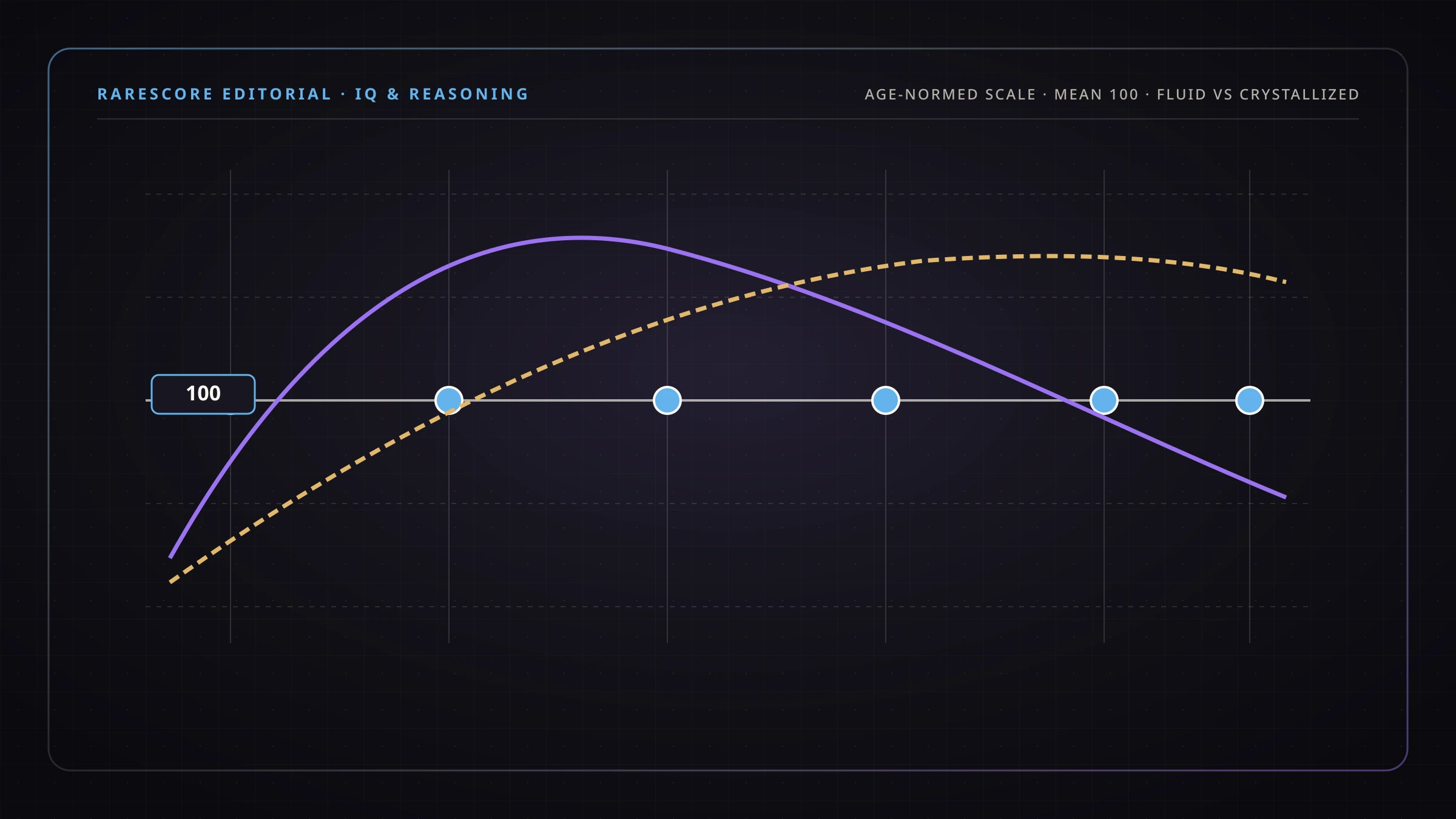
- Underneath the constant 100 center, raw cognitive skills do shift across life: processing speed and fluid reasoning typically peak in early adulthood, while vocabulary and accumulated knowledge hold steady or grow into middle age.
- An online IQ result only supports an age comparison when the test explains its reference group; use professional age-normed testing for school or clinical decisions.
This guide answers: Understand why the average IQ score is centered near 100 across age groups, how age-norming separates standardized scores from raw ability, and how to interpret an online IQ estimate.
Why age-by-age IQ charts mislead readers
If you search for average IQ by age, you will find tables that look precise: one row for age 10, another for 25, another for 70, each with a different "average." Most of those tables misunderstand how IQ scoring works. On a properly age-normed test, the average IQ is about 100 at every age. That is not a coincidence and not a claim that raw thinking stays identical from childhood to old age. It is how the score is constructed.
For a plain reading of what a score and percentile mean in general, start with What Does an IQ Score Mean?. What makes the age question confusing is that two layers move at once: raw cognitive performance changes across childhood, adulthood, and aging, while the standardized IQ scale resets the reference center to 100 inside each age peer group so scores remain comparable as percentiles.
The short answer most charts get wrong
An IQ score is not a raw count of correct answers. It is a relative rank converted into a standard scale. Test developers gather a large normative sample, group examinees by age, and set the center of each age band near 100, with a standard deviation of 15 on most modern instruments.
So when someone asks "what is the average IQ for a 12-year-old?" the accurate answer is: about 100 among 12-year-olds on a test normed for that age band. The same holds for 8-year-olds, 25-year-olds, and 65-year-olds within their respective reference groups. Charts claiming that "average IQ rises to 110 in the twenties and drops in later decades" are almost always mixing up standardized IQ scores with raw subtest totals or convenience samples from un-normed web quizzes.
If you want score bands and percentiles rather than birthday myths, read IQ score ranges and percentiles and What is a good IQ score?.
How age-norming works
Age-norming means your performance on reasoning, verbal, working-memory, and speed tasks is compared primarily with people in a matching age bracket rather than with the entire human population at once:
- Children's raw pattern, verbal, and working-memory skills develop rapidly from month to month, so pediatric batteries use narrow age bands (often broken down by year and months).
- Adult cognitive performance changes more gradually, so adult batteries use wider age brackets across early, middle, and older adulthood.
- Normative lookup tables convert raw performance into a scaled score centered at 100 within that specific age bracket.
That design serves a practical purpose. A score of 130 for an eight-year-old means "roughly two standard deviations above the mean for eight-year-olds" (see Is 130 IQ good?), not "more knowledgeable than a typical adult teacher." Treating numbers across different age brackets as if they were absolute physical measurements creates false stories about who is ahead or behind.
Unsupervised online quizzes that never publish a norming sample cannot support age-specific averages. See free IQ test vs professional assessment and how accurate online IQ tests are.
What actually changes as people age
While the standardized group average stays fixed near 100 by construction, the underlying cognitive abilities do change across the lifespan. Research in lifespan psychology consistently distinguishes two broad trajectories:
- Fluid reasoning and processing speed—solving novel matrix puzzles, mental rotation, and rapid symbol comparison—rise steeply through childhood and adolescence, tend to peak in early adulthood, and decline gradually in later decades.
- Crystallized abilities—vocabulary, verbal comprehension, general knowledge, and domain expertise—continue accumulating well into middle adulthood and remain comparatively resilient into older age.
- Health, sleep quality, education, cardiovascular fitness, language familiarity, and test practice shape individual trajectories far more than any single birthday.
Therefore, "does IQ change with age?" has two distinct answers:
- Your age-adjusted IQ score is designed to track your relative standing among same-age peers, so it often remains reasonably stable across adult retests.
- Your raw performance on timed novel puzzles versus verbal knowledge tasks shifts across decades even when your age-normed percentile stays near the same spot.
Kids, teens, and adults: same scale, different yardstick
Parents often ask for a single verdict: is this score normal for my child's age? On clinical, age-normed scales, the average still sits at 100, and the broad average band (typically 90 to 109, or 85 to 115 within one standard deviation) covers the majority of same-age peers.
Four questions matter more than a single age-chart lookup:
- Was the instrument professionally normed for the examinee's exact age band and language background?
- Were testing conditions controlled for fatigue, distraction, anxiety, and device or motor demands?
- Are you reading one composite number, or inspecting the profile across verbal, spatial, quantitative, working-memory, and speed subtests?
- Is the goal low-stakes personal curiosity, school placement, or a clinical evaluation that requires a licensed psychologist?
Teen and older-adult scores get misread in mirror-image ways. A fourteen-year-old with a high score is high relative to other fourteen-year-olds, not automatically equipped with adult judgment or executive maturity. Conversely, a strong age-normed score in older adulthood reflects high standing among peers even when timed raw speed is naturally slower than at age twenty.
How to read an online IQ result by age
RareScore's free reasoning assessment is an online estimate designed for structured practice and self-discovery, not a clinically normed diagnostic battery. Use it to explore how you handle logic, pattern, quantitative, verbal, and spatial problems—not to make school placement or clinical decisions.
When evaluating any online IQ-style score:
- Check whether the site states what its reference model represents rather than implying clinical age norms.
- Read the percentile and category breakdown alongside the headline number.
- Treat small point differences as ordinary measurement noise, particularly on short 10-question runs.
- Use a professionally administered battery (such as WAIS or WISC) whenever an educational, clinical, or legal decision depends on the score.
To try a transparent reasoning set with a clear breakdown and explicit limits, take the free RareScore IQ test and review our methodology.
Frequently asked questions
What is the average IQ by age?
On properly age-normed intelligence tests, the average IQ is set at 100 for every age group, usually with a standard deviation of 15. Tables listing different average IQs for different ages confuse standardized peer-group scores with raw task performance.
Does IQ go down as you get older?
Age-adjusted IQ scores are scaled against same-age peers, so a person's standardized score often stays relatively stable in adulthood. Raw performance on timed processing-speed and novel fluid-reasoning tasks typically softens later in life, while vocabulary and accumulated knowledge hold up much longer.
Is 100 a good IQ for a teenager or adult?
A score of 100 sits right at the 50th percentile—the center of the reference distribution—for that teenager's or adult's age band. Whether a score fits a specific goal depends on the task and the full subtest profile; see what is a good IQ score.
Reading the same 115 at age 10 and age 45
Consider a 10-year-old who scores 115 on a children's cognitive battery and a 45-year-old who scores 115 on an adult battery. Both sit one standard deviation above the mean (around the 84th percentile) within their respective age peer groups. That does not mean the 10-year-old and the 45-year-old answered the same number of raw items correctly or would tie on an untimed vocabulary test. The adult has decades more accumulated knowledge; the child is being compared only with other 10-year-olds.
Now suppose both take an un-normed 15-minute internet quiz that uses one fixed conversion table for all visitors. The child may receive a lower number simply because the vocabulary items assume adult reading exposure, while the adult may lose points on rapid screen-tapping items. Without age-specific norming, the single scale cannot separate age development from individual reasoning strength.
Use this checklist
- Does the score come from an instrument with published age-band norms or an un-normed online model?
- Are you comparing the score against same-age peers rather than treating it as an absolute lifespan unit?
- Have you separated fluid reasoning and speed from crystallized knowledge and vocabulary?
- Did you check the subtest breakdown and confidence interval instead of relying on one composite number?
- Is a licensed professional assessment required for the decision you are making?
What the evidence supports
The average IQ by age is near 100 because standardized testing is built to compare people with their age peers, not to freeze human development into one static ruler. Once you separate the age-adjusted scale from the changing raw skills underneath, viral age charts lose their mystery and subtest profiles become much more useful. When you want a transparent practice run across logic, pattern, spatial, and verbal reasoning, start the free RareScore IQ test and pair your result with What Does an IQ Score Mean?.
About the RareScore Research Desk
This guide was reviewed for claim strength, source quality, originality, and practical usefulness. The Research Desk is an editorial function, not a licensed clinical service. See the editorial standards and writing-process disclosure.
Sources and further reading
- APA Dictionary of Psychology — Intelligence Test
- Deary, I. J. (2012). Intelligence — Annual Review of Psychology
- Hartshorne, J. K., & Germine, L. T. (2015). When Does Cognitive Functioning Peak? — Psychological Science
- Nisbett, R. E., et al. (2012). Intelligence: New Findings and Theoretical Developments — American Psychologist
- AERA, APA, & NCME — Standards for Educational and Psychological Testing