Personality science • 6 min read • By RareScore Research Desk • Published 2026-10-06 • Updated 2026-10-06
What Is an Ambivert? Signs You Sit Between Introvert and Extrovert
An ambivert sits near the middle of the introversion–extraversion spectrum rather than at either extreme. Learn 8 real signs, why the middle is so common, and how to read your score.
What to know before reading further
- An ambivert is someone who scores near the middle of the continuous introversion–extraversion spectrum rather than at either extreme.
- Despite viral memes claiming ambiverts are rare, trait psychology shows that extraversion follows a roughly bell-shaped distribution—making the middle band the most common place to land.
- Ambiversion is not random inconsistency; it usually reflects either balanced extraversion sub-facets (such as high warmth paired with lower crowd-seeking) or context-sensitive social energy.
- Knowing where you sit on the spectrum helps you pace social vs deep-focus work without squeezing yourself into a rigid two-box label.
This guide answers: Define what an ambivert is in trait psychology, explain why most people sit near the center of the extraversion spectrum, and outline practical signs and work habits.
Why the two-box personality story misses the middle
Internet culture loves a clean binary: either you are an introvert who wants to cancel every plan, or an extrovert who recharges in a crowded room. Yet when many people take a trait-based assessment, they look at the questions and think, "It depends on the room, the topic, and how much sleep I got."
In personality psychology, that middle zone has had a name for nearly a century: ambivert. An ambivert sits near the center of the introversion–extraversion continuum, drawing selectively on both social engagement and solitary focus depending on the context.
What an ambivert actually is in trait psychology
Unlike type quizzes that sort everyone into two hard boxes, modern research models—most notably the Big Five personality framework—measure extraversion as a continuous dimension from 0 to 100.
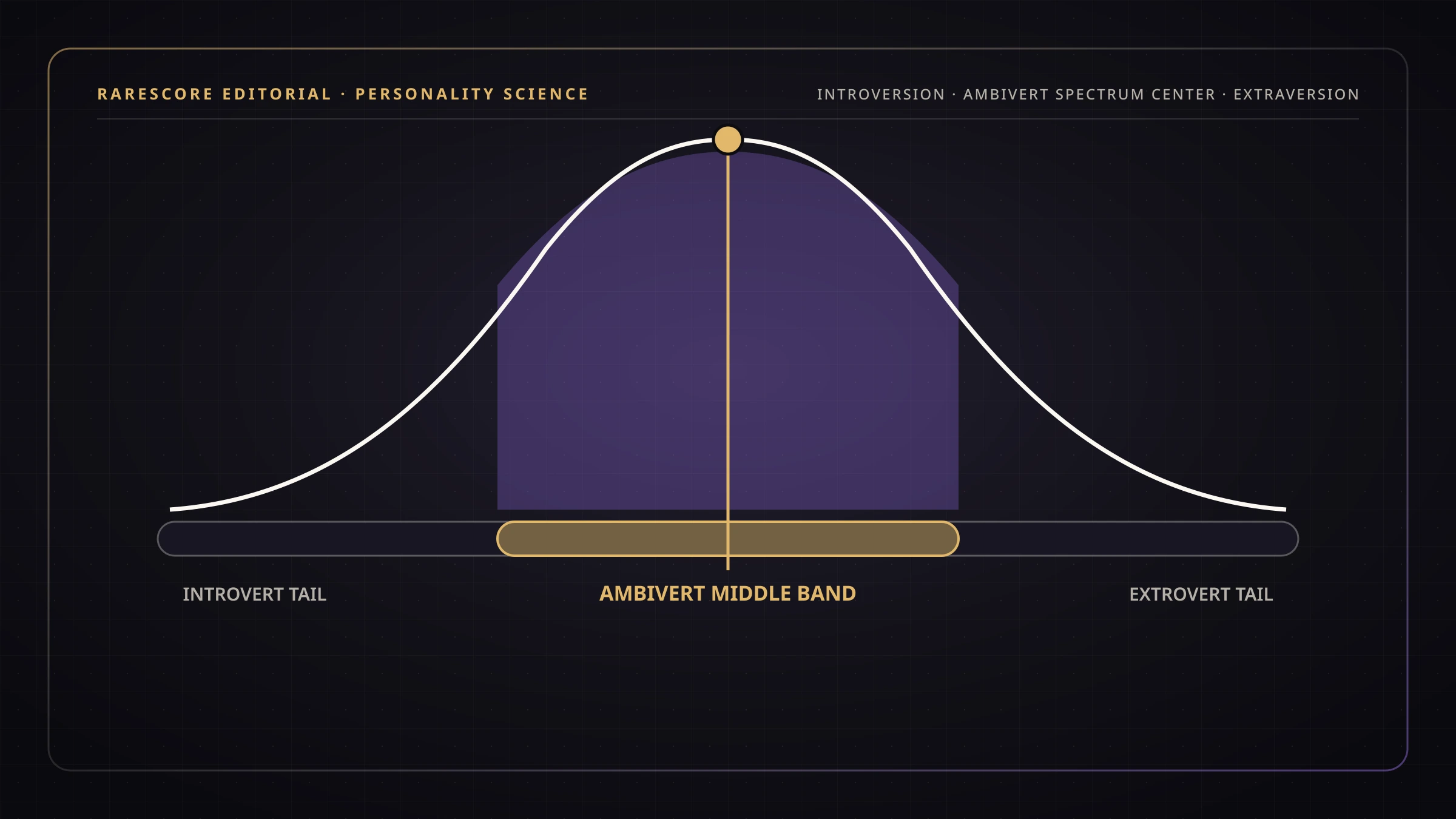
On a continuous trait scale, scores cluster around the middle like a bell curve:
- Pronounced introverts sit toward the lower tail of the extraversion distribution, strongly preferring low-stimulation environments, small circles, and extended solo processing time.
- Pronounced extroverts sit toward the upper tail, seeking frequent social interaction, rapid external feedback, and high-energy group settings.
- Ambiverts occupy the broad central band around the average—neither chronically drained by ordinary social contact nor restless the moment the house is quiet.
So if you have ever wondered "how rare is an ambivert?", the scientific answer reverses the social-media myth: sitting near the middle of the extraversion curve is statistically the most common pattern in the population, while extreme introversion and extreme extraversion are the rarer tails (see rarest personality traits).
Eight signs you are an ambivert (not just "inconsistent")
Ambiverts often get told they are contradictory because they look outgoing on Tuesday and quiet on Thursday. In practice, their behavior follows clear contextual rules—a pattern explored more broadly in Personality Contradictions Explained:
- Your social battery depends on the format, not just the headcount: Two hours of substantive conversation with four colleagues energizes you, while forty minutes of shouted small talk at a networking mixer leaves you ready to leave.
- You can lead the room when the role requires it, then disappear happily afterward: You have no trouble facilitating a workshop or pitching a client, provided you are not expected to stay at the after-party until midnight.
- Both too much isolation and too much company flatten your mood: Three straight days alone at a desk makes you sluggish, and three straight days of back-to-back social plans makes you irritable.
- You switch naturally between speaking to think and listening to synthesize: In familiar domains you jump into rapid brainstorming; in unfamiliar rooms you watch the dynamics first before contributing.
- Friends from different circles describe you differently: Work peers who see you run meetings call you an extrovert, while close friends who know how much you guard quiet Sundays call you an introvert.
- Your extraversion sub-traits split in different directions: On a detailed profile, you might score high on interpersonal warmth and assertiveness, yet moderate or low on excitement-seeking and gregariousness.
- You adjust your pace to the person across from you: With a quiet partner you slow down and leave room for silence; with a hesitant group you step in to carry the momentum.
- Forced binary questions frustrate you on personality quizzes: Prompts like "Do you prefer parties or books?" feel incomplete because your real answer is "Which party, which book, and what did my week look like?" (see why personality tests feel accurate—or overly neat).
Why ambiversion helps in work and relationships
Organizational psychologist Adam Grant and colleagues studied sales and client-facing professionals across the extraversion spectrum and found an inverted-U curve: people near the middle of the scale outperformed both strong introverts and strong extroverts.
The reason is straightforward. Strong introverts sometimes hesitated to initiate contact or press for a close, while strong extroverts occasionally talked past the client and missed subtle objections. Ambiverts naturally balanced asserting an idea with pausing to listen.
That same flexibility shows up when you evaluate how to choose a career that fits. Ambiverts often thrive in bridge roles—product management, clinical work, teaching, research leadership, design, and consulting—where half the day happens in collaborative rooms and the other half happens in uninterrupted deep work.
The main trap for ambiverts is misreading their own fatigue. Because you can handle a marathon week of meetings without obvious panic, it is easy to let your calendar fill like an extreme extrovert's—or, conversely, to retreat into solo work for so long that your energy stalls for lack of human friction.
How to check where you land on the spectrum
To see whether you sit in the ambivert band or lean distinctly toward one end:
- Look for a test that reports extraversion as a continuous score or percentile rather than a binary letter.
- Inspect the underlying facets—warmth, assertiveness, activity level, and social stimulation seeking—to see where your middle score comes from.
You can map your extraversion percentile alongside the rest of your Big Five traits on RareScore's free personality test, explore your broader profile on the Who Am I assessment, and review our scoring design in the methodology.
Frequently asked questions
What does ambivert mean?
An ambivert is a person whose personality sits near the middle of the introversion–extraversion continuum. Instead of strongly favoring solitude or constant social stimulation in every situation, an ambivert shifts between outgoing engagement and quiet focus based on the setting, topic, and energy level.
Are ambiverts rarer than introverts or extroverts?
No. Because extraversion is a continuous trait that clusters near the center of a bell curve, more people fall into the middle ambivert range than into the extreme introvert or extreme extrovert tails. Binary tests hide this by forcing everyone just above or below the midpoint into two separate labels.
Can an introvert become an ambivert?
People's baseline temperament is relatively stable, but extraversion scores and comfort with social leadership often shift modestly across life stages and roles. More often, someone who thought they were a strict introvert discovers that they actually sit near the middle once they separate social anxiety or bad room formats from true introversion.
Why two 50th-percentile ambiverts can look very different
Imagine two teammates who both score right at the 50th percentile on overall extraversion—textbook ambiverts on the headline scale. When you open their facet breakdown, however, the middle number comes from two different recipes.
Teammate A scores at the 25th percentile on crowd-seeking and party small talk, and at the 75th percentile on assertiveness and vocal leadership in structured meetings. Teammate B shows the mirror image: 75th percentile on warmth and friendly one-on-one chat, and 25th percentile on taking charge of a loud group debate. Both sit at the exact midpoint of the extraversion spectrum, and both feel miscast by a strict "introvert or extrovert" label—yet Teammate A recharges by skipping the happy hour after leading the strategy review, while Teammate B recharges by having coffee with two colleagues instead of presenting on stage.
Use this checklist
- Did you check your continuous extraversion percentile instead of relying on a binary introvert/extrovert label?
- Have you separated your sub-facets (assertiveness, warmth, activity level, crowd-seeking) to see why you land near the middle?
- Do you know which specific social formats energize you versus which ones drain you?
- Does your weekly schedule alternate collaborative blocks with protected solo focus blocks?
- Have you distinguished true introversion from temporary burnout or social nervousness?
What the evidence supports
Being an ambivert is not a failure to pick a side—it is the natural result of how human personality traits distribute along a spectrum. Once you drop the two-box myth and look at your specific mix of warmth, assertiveness, and stimulation needs, you can design your work and social calendar around what actually restores your energy. See where you land on the full continuum with RareScore's free personality test.
About the RareScore Research Desk
This guide was reviewed for claim strength, source quality, originality, and practical usefulness. The Research Desk is an editorial function, not a licensed clinical service. See the editorial standards and writing-process disclosure.
Sources and further reading
- Grant, A. M. (2013). Rethinking the Extraverted Sales Ideal: The Ambivert Advantage — Psychological Science
- McCrae, R. R., & Costa, P. T., Jr. (1987). Validation of the Five-Factor Model of Personality Across Instruments and Observers — Journal of Personality and Social Psychology
- Fleeson, W. (2001). Toward a Structure- and Process-Integrated View of Personality: Traits as Density Distributions of States — Journal of Personality and Social Psychology
- APA Dictionary of Psychology — Ambiversion
- International Personality Item Pool (IPIP) — Scientific Collaboratory for the Development of Advanced Measures of Personality