Personality science • 5 min read • By RareScore Research Desk
Why Personality Tests Feel Accurate—Even When They Are Vague
The Barnum effect, confirmation bias, flattering language, and the design choices that make a personality result more trustworthy.
What to know before reading further
- Vague, balanced, and flattering statements can feel uniquely personal to many readers.
- Confirmation bias makes matches easier to remember than misses.
- Specific context, observable behavior, and stated uncertainty make an interpretation more testable.
- A report should include tradeoffs and counterevidence rather than converting every result into praise.
This guide answers: Explain the Barnum effect, confirmation bias, flattering ambiguity, and how to test whether a result is genuinely specific.
Perceived accuracy is co-produced by the reader
A personality description does not create the feeling of recognition by itself. The reader actively completes it—selecting memories that fit, translating abstract language into personal examples, and supplying exceptions that preserve the overall story. This interpretive participation is why the same paragraph can feel intimate to many different people.
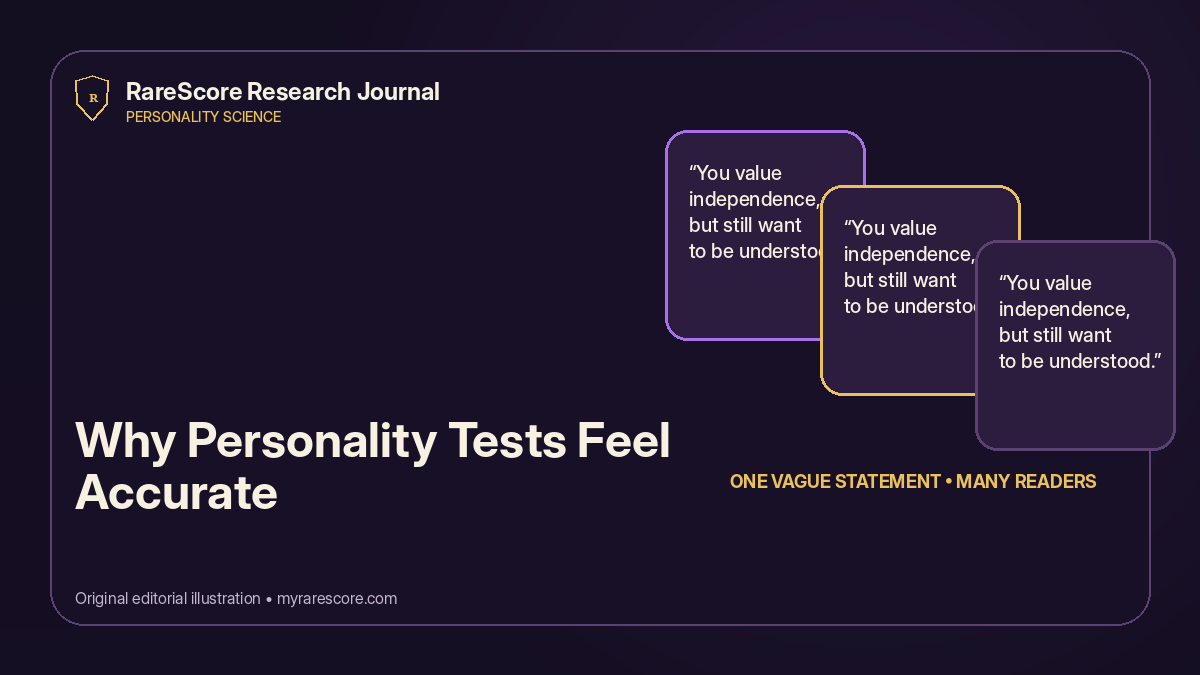
Specificity changes the burden of proof. “You value independence but sometimes want reassurance” invites the reader to do most of the work. “You usually accept private criticism, but public criticism makes immediate correction more likely” identifies a context, a trigger, and an observable response. The second statement can be wrong in a meaningful way, which is exactly why it is more informative.
Vague statements are easy to personalize
Statements such as “You value independence but sometimes need reassurance” apply to a large percentage of people. When presented as a personal result, the reader supplies memories that make the statement feel specific. This is often called the Barnum or Forer effect.
A result can feel emotionally true without having been uniquely produced by the answers.
Flattering ambiguity increases acceptance
People are more likely to accept positive statements and reinterpret weaknesses as hidden strengths. “You overthink because you care deeply” may feel compassionate, but it can also avoid saying anything testable.
A credible result should include costs, conditions, and evidence—not only compliments.
Readers remember the hits and explain away the misses
When a report contains many statements, a few strong matches can dominate the impression. Inaccurate sections may be ignored, interpreted creatively, or blamed on mood.
This does not mean self-reflection is useless. It means accuracy feedback should be collected section by section rather than through one general “Did this feel right?” question.
Specificity should come from repeated evidence
A stronger statement names a pattern, the context that activates it, and the tradeoff. For example: “You are usually patient, but public disrespect shortens your time horizon and makes immediate correction more likely.”
That claim is more useful because it can be compared with real behavior. It should also require support from several questions, not one dramatic choice.
The user should be able to inspect the reasoning
Explainability improves trust. A result can show selected answers, the dimensions they influenced, and how strongly the evidence supports the conclusion.
The goal is not to expose every scoring weight. It is to show enough of the chain that the report is more than polished fortune-telling.
How to judge a personality test
Look for clear methodology, honest limitations, varied question formats, non-diagnostic language, and a result that includes both strengths and costs. Be skeptical of rigid labels presented as destiny.
A useful test leaves you with better questions about your behavior, not a permanent box.
A simple way to test whether a result is specific
Remove the title and ask several people to rate how well the same report describes them. If nearly everyone recognizes themselves, the language may be broadly applicable rather than personalized.
Another check is prediction. Does the report name a context and behavior that can be observed later, or only a quality that can be interpreted after anything happens?
What makes an interpretation more trustworthy
Trustworthy interpretations use repeated evidence, state confidence, preserve contradictions, and distinguish data from inference. They avoid diagnostic language and make it possible for the user to disagree with a section.
The report should also show tradeoffs. A result that converts every weakness into praise is optimized for acceptance, not accuracy.
- Specific context and trigger
- More than one supporting question
- A stated uncertainty level
- A plausible counterexample
- Both advantage and potential cost
- An accessible explanation of the scoring model
Common questions
Does the Barnum effect make all personality tests meaningless? No. It explains one source of perceived accuracy. Specific, repeatable, evidence-linked results can still be useful.
Why are type labels so memorable? Categories compress complexity into a story. That can support reflection, but the label should not replace the underlying dimensions and contexts.
What is the best feedback question? Ask about individual sections and specific predictions, not only whether the whole report “felt accurate.”
Run the swap test
Take a result paragraph, remove the title, and give it to several people who received different outcomes. Ask each person to rate how specifically it fits. If nearly everyone sees themselves in it, the language may be broadly acceptable rather than individualized. This is the swap test: the interpretation should lose accuracy when moved to the wrong profile.
A second test is prospective. Before the next relevant event, turn the report into a prediction. For example: “When criticized publicly, I will feel a stronger need to correct the record than when criticized privately.” Record what happens. A statement that can predict a context-dependent response carries more information than a description that can be retrofitted to any outcome.
This does not mean every useful result must be surprising. Familiar truths can be accurate. The point is that confidence should come from repeated evidence, specificity, and failed alternatives—not merely from the emotional relief of feeling seen.
Use this checklist
- Run the swap test with a result from another profile.
- Convert a claim into a prediction before the next event.
- Look for context, trigger, behavior, and tradeoff.
- Notice whether every weakness is rewritten as praise.
- Require visible uncertainty and counterevidence.
What the evidence supports
Feeling recognized is valuable, but it is not a validation study. The responsible test welcomes a second question: what evidence made this statement more likely for me than for someone with a different result? Specific contexts, repeated signals, uncertainty, and inspectable tradeoffs provide an answer. Vague praise does not. A report earns trust by being capable of meaningful error, not by being impossible to disagree with. A strong report should make disconfirmation possible. It should identify the situations in which the pattern is expected, the evidence that supported it, and the conditions under which the interpretation may fail. Specificity creates risk for the writer, because the statement can be wrong; that risk is precisely what separates an inspectable analysis from language designed to feel universally personal. Good interpretation welcomes the possibility of being corrected by behavior. It should show where the interpretation is uncertain and what observation would count against it.
About the RareScore Research Desk
This guide was reviewed for claim strength, source quality, originality, and practical usefulness. The Research Desk is an editorial function, not a licensed clinical service. See the editorial standards and writing-process disclosure.