Personality science • 5 min read • By RareScore Research Desk
Why Your Personality Can Contain Opposites
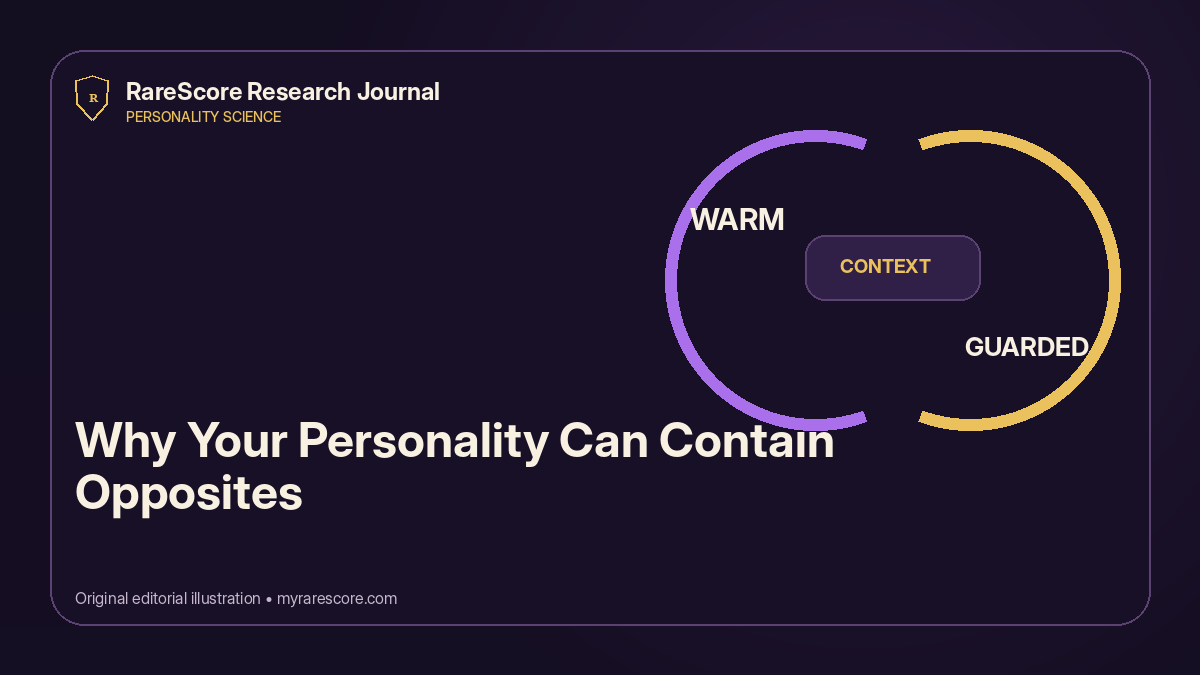
You can be independent and approval-sensitive, compassionate and direct, disciplined and adaptable. Here is why personality contradictions are often context patterns.
What to know before reading further
- Traits describe distributions of behavior, not identical behavior in every situation.
- Opposite-looking responses may protect the same underlying goal.
- Public versus private, safe versus threatened, and close versus distant contexts can activate different patterns.
- A strong report preserves meaningful contradictions instead of forcing one flattering label.
This guide answers: Explain why apparently opposite traits can coexist and emerge in different situations.
A contradiction may be a conditional rule
People often describe themselves with opposing sentences: “I trust easily, but I never forget betrayal,” or “I hate attention, but I care deeply about being respected.” These are not necessarily inconsistencies. They may be compressed versions of conditional policies: trust is offered in low-risk settings but withdrawn after evidence of exploitation; attention is unwanted unless the person’s competence or standing is at stake.
A high-quality assessment should therefore look for the condition that flips the response. Without that condition, the report is forced to choose one adjective and discard the other. With it, the apparent contradiction becomes a more precise statement about how the person allocates trust, control, recognition, or emotional exposure across situations.
A contradiction is not automatically an error
People often expect a personality result to choose one side: introvert or extrovert, emotional or logical, independent or relational. Real behavior is less tidy. A person can want deep closeness and still react strongly to control. Another can care about emotional impact and still believe difficult truths should be spoken directly.
These combinations become understandable when the test asks about motives and context rather than averaging everything into one label.
Context changes which trait is useful
You may be socially quiet with strangers and highly assertive with close friends. You may tolerate uncertainty in creative work but demand control in relationships. Those are not necessarily inconsistencies. They may be learned strategies for different risks.
The key question is whether the shift is predictable. If public evaluation activates caution while private trust activates boldness, the pattern itself is meaningful.
The same behavior can protect different motives
Consider someone who avoids conflict. They may value harmony, fear rejection, wait strategically, or simply decide the issue is not worth attention. The visible behavior is identical, but the internal structure is different.
This is why direct questions such as “Are you confrontational?” are limited. Scenario choices and motive-separation follow-ups can reveal more.
Four common personality tensions
Some tensions appear repeatedly because the underlying needs are both legitimate.
- Autonomy and belonging: closeness without losing authorship
- Empathy and directness: truth without unnecessary damage
- Discipline and adaptability: stable goals with flexible methods
- Recognition and independence: wanting to be seen without letting the audience choose the direction
A healthy tension creates range
When both sides are available, the person can respond to the situation. Discipline prevents drift; adaptability prevents rigidity. Empathy detects emotional cost; directness prevents hidden resentment.
A tension becomes costly when one side is denied. Someone who insists they never care about recognition may become unusually reactive when overlooked. Someone who identifies only as kind may avoid necessary boundaries until frustration erupts.
What a good result should do
A useful personality analysis should not flatten contradictions into an average. It should name the conditions under which each side appears, show the evidence, and explain the tradeoff.
The goal is not a perfect label. It is a better map of when your strengths cooperate and when they compete.
Why average scores can hide the most important pattern
Suppose a person is highly direct at work and highly avoidant in intimate conflict. Averaging those answers may produce a moderate directness score that accurately describes neither context.
A better report preserves the interaction: directness becomes available when competence is at stake, while closeness activates caution. The difference between contexts is itself part of the personality pattern.
How to work with an internal tension
Do not force one side to win permanently. Instead, identify the legitimate purpose of each side and the signal that should decide which one leads. Autonomy may lead when pressure is manipulative; belonging may lead when support is genuine.
The goal is range with awareness. A person becomes less predictable to their own automatic defenses and more responsive to present evidence.
- Name both needs without insulting either one
- Identify the situations that activate each side
- Notice which side is missing under stress
- Choose a behavior that protects both values where possible
Common questions
Does contradiction mean the person answered dishonestly? Not necessarily. Context, motive, wording, and genuine ambivalence can produce different answers. Dishonesty should never be inferred from one inconsistency.
Can opposite traits both be high? Yes, especially when they are not true opposites. Empathy and directness, for example, can coexist and become powerful when timing is handled well.
What should a report do with mixed evidence? Preserve it, identify the contexts, and lower confidence when the pattern cannot yet be resolved.
How to turn a contradiction into a testable statement
Take the sentence, “I am independent, but criticism affects me.” It sounds inconsistent only if independence is defined as emotional invulnerability. A more precise hypothesis is that the person resists external control but cares strongly about judgments of competence. The contradiction can be tested by comparing criticism about skill, morality, appearance, loyalty, and belonging. If competence criticism reliably produces a stronger reaction, the pattern is not general approval seeking; it is identity protection around mastery.
The same method works for warmth and distance. A person may be generous with practical help but reluctant to disclose uncertainty. They are not simply “caring but guarded.” The useful questions are what kind of closeness feels safe, what information creates vulnerability, and what response from another person increases or decreases access. Precision replaces a poetic contradiction with a conditional behavioral rule.
This is also why a report should retain counterevidence. If most answers support patience but public disrespect produces immediate confrontation, the exception is not noise to be erased. It may be the most important part of the profile because it identifies the boundary at which the person’s normal strategy changes.
Use this checklist
- Rewrite each contradiction as an if-then statement.
- Compare public and private versions of the same event.
- Identify which motive is protected by each response.
- Search for counterexamples instead of dismissing them.
- Preserve the tension when both sides are repeatedly supported.
What the evidence supports
Contradictions are often where a profile becomes specific. Broad averages describe the center of behavior; the exception reveals the boundary condition. A report that says only “you are patient” is less useful than one that shows patience collapsing when loyalty is questioned publicly. Precision does not eliminate complexity. It gives complexity a structure that can be observed, challenged, and changed.
About the RareScore Research Desk
This guide was reviewed for claim strength, source quality, originality, and practical usefulness. The Research Desk is an editorial function, not a licensed clinical service. See the editorial standards and writing-process disclosure.