Personality science • 6 min read • By RareScore Research Desk • Published 2026-10-07 • Updated 2026-10-07
Dark Triad Personality Traits: Narcissism, Machiavellianism, and Psychopathy Explained
The Dark Triad—narcissism, Machiavellianism, and subclinical psychopathy—explained in plain psychology: what each trait measures, how they differ, and what online tests cannot diagnose.
What to know before reading further
- Coined by psychologists Delroy Paulhus and Kevin Williams in 2002, the Dark Triad refers to three distinct subclinical personality traits: narcissism, Machiavellianism, and psychopathy.
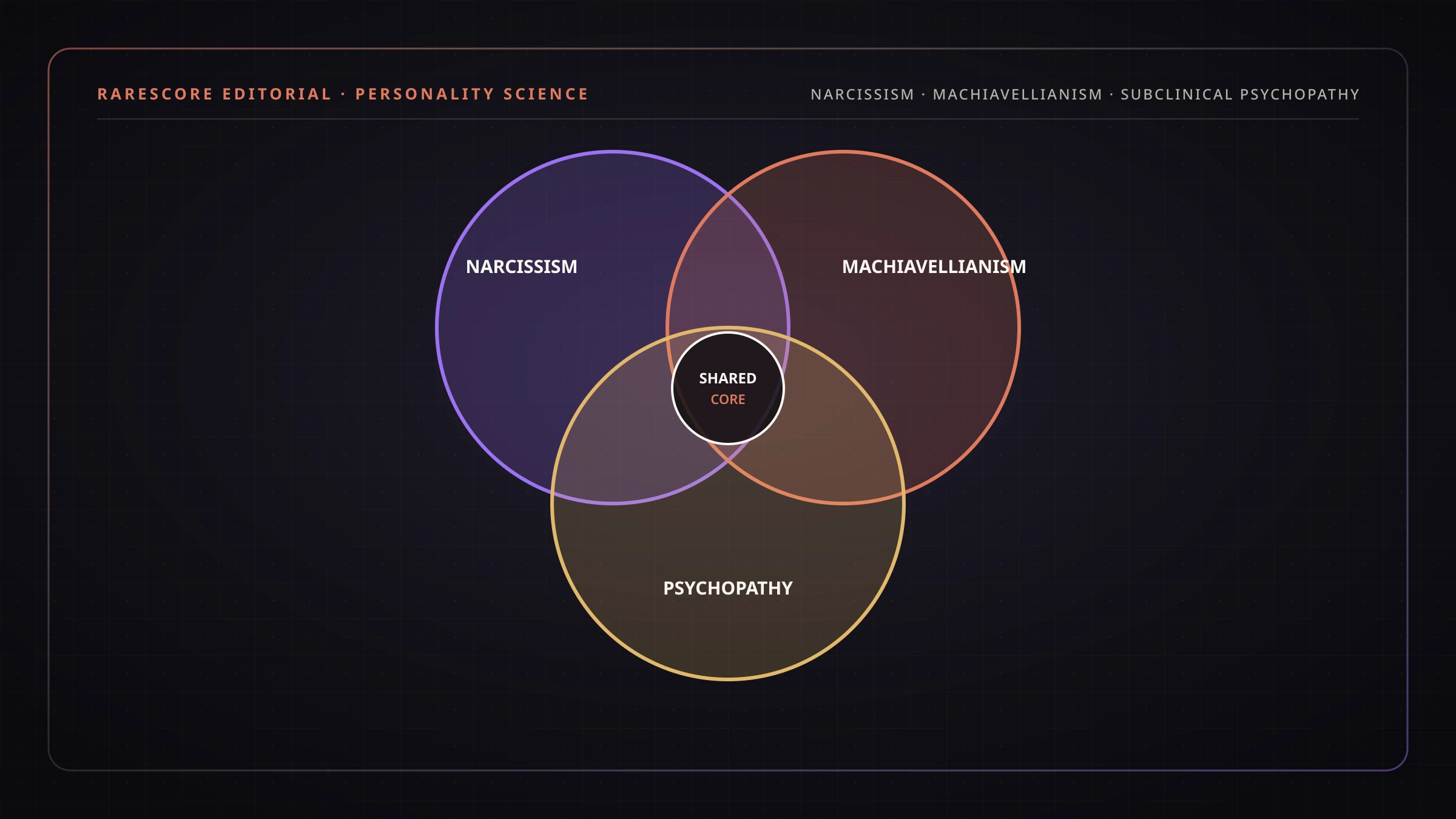
- All three share an antagonistic core—callousness, status or self-interest priority, and willingness to use others—yet they differ sharply in time horizon, impulse control, and need for applause.
- Research measures these traits on continuous subclinical scales in the general population; an online questionnaire cannot diagnose Narcissistic or Antisocial Personality Disorder.
- In Big Five and HEXACO models, Dark Triad scores map closely onto low agreeableness and low honesty-humility rather than forming a mysterious superpower.
This guide answers: Understand what the three Dark Triad personality traits are in research psychology, how they overlap and differ, and how to separate subclinical trait scales from clinical diagnosis.
Separating research psychology from viral villain tropes
On social media, the phrase Dark Triad personality traits usually appears next to dramatic black-and-red graphics, fictional antiheroes, or checklists promising to expose everyone in your office. In academic personality psychology, the concept is much more specific—and much less cinematic.
Psychologists Delroy Paulhus and Kevin Williams introduced the term "Dark Triad" in 2002 to study three socially aversive traits that show up at varying levels in ordinary, non-clinical populations: subclinical narcissism, Machiavellianism, and subclinical psychopathy. Studying them together clarified both why they look similar from a distance and why they should not be collapsed into a single label.
The three traits in plain language
Each member of the triad has its own history, measurement scale, and behavioral signature:
- Subclinical narcissism: Centered on grandiosity, entitlement, and an ongoing need for admiration and status reinforcement. People high on subclinical narcissism tend to view themselves as exceptional, expect special treatment, and react defensively when their status is questioned—often driven by a fragile or inflated ego image rather than cold calculation.
- Machiavellianism: Named after political theorist Niccolò Machiavelli and introduced into psychology by Richard Christie and Florence Geis, Machiavellianism reflects strategic manipulation, cynicism about human motives, and a long-term focus on coalition-building, leverage, and reputation management. Unlike impulsive aggression, high Machiavellianism is patient and pragmatic: if honesty serves the goal today, it looks cooperative.
- Subclinical psychopathy: Marked by low empathy, emotional callousness, thrill-seeking, and weak impulse control or remorse. Where Machiavellianism plans several moves ahead, subclinical psychopathy is characterized by short-term recklessness, low anxiety around risk, and indifference to the harm caused along the way.
What they share vs how they differ
Why do researchers group these three traits into a triad? Factor-analytic studies show that all three share a common core of interpersonal antagonism: low empathy, willingness to exploit others when convenient, and a view of relationships as instruments or status mirrors.
In standard personality frameworks, that shared core aligns strongly with low Agreeableness on the Big Five personality traits and especially with low Honesty-Humility on the six-factor HEXACO model.
Despite that shared center, the three traits pull behavior in very different directions under pressure:
- Need for applause vs anonymity: Narcissism craves visible credit and spotlight; Machiavellianism is often comfortable pulling strings quietly behind the scenes if the outcome pays off.
- Impulse control and time horizon: Machiavellianism typically preserves impulse control to protect future leverage, whereas subclinical psychopathy is associated with impulsive risk-taking and short-term gratification.
- Self-deception vs cold calculation: Narcissistic entitlement often includes genuine self-enhancement ("I truly deserve more credit because my contribution was superior"), while Machiavellian cynicism knows the game is tilted and plays it deliberately.
Because extreme combinations of these traits are relatively uncommon in general population norms, they also come up in discussions of unusual personality trait combinations.
Subclinical trait scales vs clinical personality disorders (hard boundary)
This distinction is the most important rule in the entire literature:
- Subclinical trait inventories (such as the Short Dark Triad, or SD3, and the Dirty Dozen) measure continuous attitudes in everyday populations—agreement with statements about status, cynicism, or thrill-seeking.
- Clinical diagnoses—such as Narcissistic Personality Disorder (NPD) or Antisocial Personality Disorder (ASPD)—are formal psychiatric conditions defined in diagnostic manuals, requiring persistent functional impairment, developmental history, and evaluation by a licensed clinician.
A high score on an online Dark Triad quiz or personality scale is not a clinical diagnosis of yourself or anyone else. Nor does scoring moderately on assertiveness, skepticism, or thick-skinned composure under stress make someone "a psychopath." For what self-report questionnaires can and cannot verify, read Are Personality Tests Accurate?.
How these patterns show up in work, trust, and ethical tradeoffs
Why do organizational and moral psychologists study the Dark Triad so closely? Because in short bursts, each trait can mimic a desirable workplace quality:
- Grandiose confidence can look like visionary leadership during a pitch interview.
- Strategic calculation can look like shrewd negotiation.
- Emotional detachment can look like coolness under fire.
Over longer stretches, however, high antagonistic traits reliably erode psychological safety, credit-sharing, and reciprocity. When you evaluate how people navigate trust, boundaries, and closeness, the consistent warning sign is not occasional bluntness—it is a pattern where rules, credit, and empathy only flow in one direction.
The same dynamics show up in ethical decision-making. On hypothetical sacrifice dilemmas, callousness and low aversion to harming others can sometimes produce the same "utilitarian" headcount answer as impartial philosophical reasoning—for completely different underlying reasons. For how moral assessments separate genuine principle from indifference to harm, read What Morality Tests Really Measure.
How to explore your trait and value profile on RareScore
RareScore does not publish sensationalized "villain scores" or clinical diagnostic labels. Instead, you can inspect the real psychological building blocks—agreeableness, conscientiousness, honesty, loyalty, and harm tradeoffs—directly:
- Map your core trait percentiles on the free personality test.
- See which duties and values you protect when principles collide on the free morality test.
- Read how our scoring models and limits work in the methodology.
Frequently asked questions
What are the three Dark Triad personality traits?
The Dark Triad consists of narcissism (grandiosity, entitlement, and need for admiration), Machiavellianism (strategic manipulation, cynicism, and calculated self-interest), and subclinical psychopathy (callousness, low remorse, and impulsivity).
Is the Dark Triad a mental illness or clinical diagnosis?
No. In psychology, the Dark Triad is a research construct measuring three subclinical personality traits along continuous scales in the general population. Only a licensed mental health professional can diagnose clinical conditions such as Narcissistic Personality Disorder or Antisocial Personality Disorder.
How does the Dark Triad relate to the Big Five personality traits?
Across studies, all three Dark Triad traits correlate negatively with Big Five Agreeableness (and with the Honesty-Humility factor in the HEXACO model). They diverge on other dimensions: narcissism often pairs with higher Extraversion, while subclinical psychopathy often pairs with lower Conscientiousness.
Why charm, strategy, and impulsivity split over six months
Imagine three newly hired project directors who all seem intensely ambitious during their first two weeks. Director A (high subclinical narcissism) dominates town halls, takes personal ownership of every visible win, and bristles whenever a junior analyst questions an assumption in public. Director B (high Machiavellianism) is polite and low-key in meetings, quietly tracks who controls budget approvals, and withholds key context from peers when sharing it would dilute their own leverage. Director C (high subclinical psychopathy) takes aggressive shortcuts on compliance checks, burns through vendor relationships without concern, and moves on before the fallout arrives.
At a superficial glance, a frustrated colleague might call all three "toxic." In psychological terms, however, their behavior is driven by three distinct mechanisms—status hunger, calculated leverage, and callous impulsivity—and each creates a different risk for the team. Naming the specific pattern is far more useful than throwing a dramatic label at the room.
Use this checklist
- Have you distinguished between narcissism (status/admiration), Machiavellianism (calculated strategy), and psychopathy (callous impulsivity)?
- Are you keeping a strict line between subclinical personality trait scales and clinical psychiatric diagnoses?
- Did you check how much of the pattern is explained by Big Five Agreeableness, Conscientiousness, and Honesty-Humility?
- In ethical dilemmas, have you separated principled outcome math from simple indifference to harming one person?
- Are you evaluating long-term patterns of reciprocity and accountability rather than a single heated interaction?
What the evidence supports
The Dark Triad is useful in psychology not because it turns everyday people into movie villains, but because it untangles three different ways self-interest can override empathy: chasing applause, playing for leverage, and acting without remorse or restraint. When you want a grounded look at how your own traits and ethical priorities operate without sensational labels, take RareScore's free personality test and free morality test.
About the RareScore Research Desk
This guide was reviewed for claim strength, source quality, originality, and practical usefulness. The Research Desk is an editorial function, not a licensed clinical service. See the editorial standards and writing-process disclosure.
Sources and further reading
- Paulhus, D. L., & Williams, K. M. (2002). The Dark Triad of Personality: Narcissism, Machiavellianism, and Psychopathy — Journal of Research in Personality
- Jones, D. N., & Paulhus, D. L. (2014). Introducing the Short Dark Triad (SD3): A Brief Measure of Dark Personality Traits — Assessment
- Muris, P., Merckelbach, H., Otgaar, H., & Meijer, E. (2017). The Malevolent Side of Human Nature: A Meta-Analysis and Critical Review of the Literature on the Dark Triad — Perspectives on Psychological Science
- Lee, K., & Ashton, M. C. (2005). Psychopathy, Machiavellianism, and Narcissism in the Five-Factor Model and the HEXACO Model of Personality Structure — Personality and Individual Differences
- APA Dictionary of Psychology — Dark Triad