Morality • 5 min read • By RareScore Research Desk
What Morality Tests Can—and Cannot—Tell You
How moral dilemmas reveal value priorities, why every option should have a cost, and why a morality score should never label someone good or bad.
What to know before reading further
- Moral dilemmas reveal tradeoffs among values, duties, relationships, and consequences.
- Answers are sensitive to wording, emotional distance, cultural experience, and whether the scenario feels realistic.
- Hypothetical judgment is not identical to behavior when real costs are present.
- A responsible result describes reasoning patterns without declaring the user morally superior or defective.
This guide answers: Learn what moral dilemmas reveal about priorities and why they cannot prove that someone is morally good or bad.
A dilemma is a compressed moral simulation
Moral dilemmas strip away much of real life and concentrate a conflict: loyalty against fairness, truth against compassion, rights against outcomes. This compression is useful because it makes priorities visible. It is also dangerous because the omitted details—history, power, uncertainty, accountability, and real emotional cost—often determine what a responsible action would be.
The best interpretation does not infer character from the selected option. It examines which features changed the answer. Would the choice differ if the harmed person were a stranger, if the outcome were uncertain, if the decision were public, or if the user personally benefited? Those changes reveal the architecture of the reasoning more clearly than the dramatic scenario alone.
A morality test should map priorities, not judge a soul
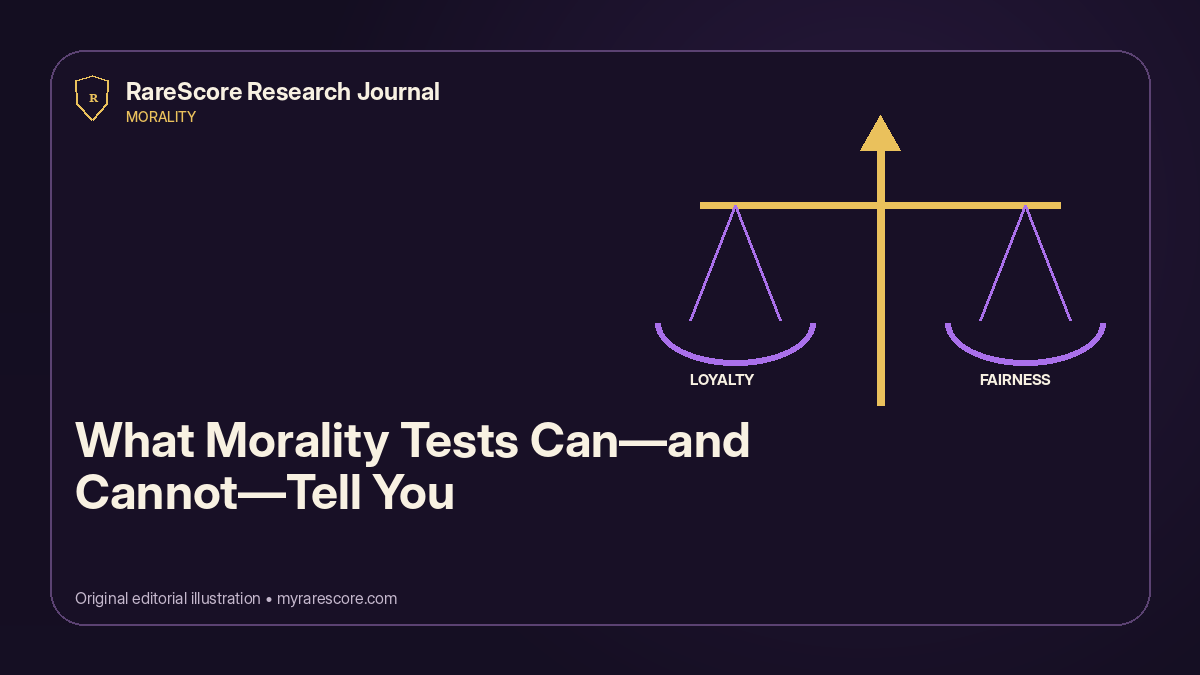
Most difficult moral decisions involve competing values. Loyalty can conflict with fairness. Honesty can conflict with protection. Rules can conflict with compassion. A serious dilemma makes the cost visible.
If one option is obviously kind, honest, legal, and consequence-free, the question measures whether the user can spot the socially desirable answer. It does not reveal much about moral structure.
Different moral frameworks ask different questions
A consequence-focused approach asks which action produces the least harm or greatest benefit. A duty-focused approach asks which principles or obligations should not be violated. A virtue-focused approach asks what a good or wise person would become through the action.
People often use several frameworks at once. The tension between them is part of the result.
Loyalty is morally powerful—and morally dangerous
Loyalty makes relationships durable and creates obligations that extend beyond convenience. It can also protect wrongdoing when belonging becomes more important than accountability.
A good test distinguishes public protection, private correction, secrecy, proportionality, and the seriousness of the harm.
Intent, action, and outcome are different evidence
Someone can act with good intent and cause serious harm. Another can break a rule for selfish reasons and accidentally help. Moral judgment changes depending on how a person weighs intention, foreseeable consequences, and responsibility for repair.
Questions should specify what the decision-maker knew at the time. Otherwise the test may reward hindsight rather than moral reasoning.
What a useful morality result looks like
Instead of “You are 82% moral,” a result can describe recurring priorities: fairness-first, loyalty-protective, consequence-sensitive, rule-centered, restorative, or context-dependent.
The analysis should include the value protected, the value accepted as a cost, and the contexts that changed the person’s choice.
The limits matter
A hypothetical answer is not the same as real behavior. People may imagine themselves as braver, kinder, or more principled than they are under actual pressure. Cultural background also affects how duties and relationships are understood.
The best use of a morality test is reflection: which cost did you notice first, and which cost did you minimize?
How to write a revealing ethical dilemma
A useful dilemma specifies who knows what, which outcomes are foreseeable, what obligations already exist, and whether repair is possible. Without those details, respondents may answer different imagined versions of the problem.
The options should protect competing values rather than include one cartoonishly selfish choice. The explanation can then describe the priority expressed and the cost accepted.
Use the result as a conversation, not a verdict
Moral reasoning can change when facts change. Asking what information would reverse the decision is often more revealing than asking whether the original choice was right.
A strong report also distinguishes private belief from public action. People may condemn an act while still believing punishment would create more harm, or value loyalty while requiring accountability.
- Which value did the choice protect first?
- Which person carried the cost?
- Was the harm foreseeable?
- Would the answer change if the relationship changed?
- What form of repair would matter?
Common questions
Why not give one morality percentage? A single percentage implies a common scale of moral goodness that the dilemmas usually cannot justify. Mapping value priorities is more honest.
Can the same choice be moral for different reasons? Yes. Protecting a friend can reflect compassion, fear, loyalty, self-interest, or a belief in private correction. Follow-up reasoning matters.
Should illegal choices always score lower? Law and morality overlap but are not identical. A test should identify legality as one consideration rather than silently treating it as the complete moral rule.
How one changed detail reveals the value underneath
Consider a manager who discovers that a talented employee falsified a small record to protect a coworker from an unfair punishment. Reporting the act supports rule consistency and institutional trust. Concealing it protects loyalty and may correct an unjust outcome. The first answer is informative, but the diagnostic detail is what changes it.
Would the choice differ if the falsification created financial risk, if the coworker were a stranger, if the rule were clearly legitimate, or if the manager personally benefited from silence? Each variation isolates a different moral consideration. Increased harm tests consequence sensitivity. Changing the relationship tests loyalty. Personal benefit tests whether the principle survives self-interest. Public versus private accountability tests reputation and institutional duty.
A strong morality report therefore avoids labels such as “good,” “cold,” or “corrupt.” It might say that the person gives relationships substantial moral weight but becomes more rule-oriented when harm becomes irreversible. That statement is narrower, testable, and more useful than a total morality score that hides the tradeoff.
Use this checklist
- Change one fact at a time and observe whether the answer changes.
- Separate intent, action, outcome, duty, and relationship.
- Ask whether personal benefit alters the principle.
- Avoid converting hypothetical judgment into a character verdict.
- Describe the tradeoff the person was willing to accept.
What the evidence supports
The value of a morality test lies in making tradeoffs visible. It can show that loyalty receives priority until harm becomes severe, or that rules matter most when personal benefit is involved. Those patterns can support reflection and conversation. They should not be converted into a universal moral rank, because hypothetical judgment is only one form of evidence and moral life contains information the scenario deliberately leaves out.
About the RareScore Research Desk
This guide was reviewed for claim strength, source quality, originality, and practical usefulness. The Research Desk is an editorial function, not a licensed clinical service. See the editorial standards and writing-process disclosure.