Morality & values • 8 min read • By RareScore Research Desk • Published 2026-10-02 • Updated 2026-10-02
Trolley Problem Variations: 12 Versions That Change the Answer
Twelve trolley problem variations—from the switch and footbridge to loop, transplant, and self-driving cars—and what each one reveals about harm, intention, and tradeoffs.
What to know before reading further
- The trolley problem is not one puzzle; it is a family of trolley problem variations that keep the five-versus-one body count constant while changing the kind of action required.
- People who pull the switch often refuse to push someone off a footbridge because intention, personal contact, and using a person as a means change even when the death toll matches.
- Across the twelve classic versions, five levers move people's answers: means versus side effect, personal force, rights and professional roles, relationship or blame, and certainty.
- Changing one variable at a time in discussion reveals which principle you protect first and what cost your principle accepts.
This guide answers: Understand the classic trolley problem and twelve variations that change the answer, plus what each version reveals about harm, intention, contact, and roles.
Why trolley variations split intuition from arithmetic
The trolley problem is not one puzzle. It is a family of trolley problem variations that keep the body count the same and change the kind of action you must take. That is why people who pull the switch often refuse to push someone off a bridge: outcomes match, but intention, contact, and using a person as a means do not.
If you want a broader set of everyday dilemmas, start with 25 Moral Dilemma Questions. For classroom use, see Moral Dilemma Questions for Students. This guide stays on the trolley family and what each version is designed to test. Philosophers Philippa Foot and Judith Jarvis Thomson developed the switch, transplant, footbridge, and loop cases not as parlor tricks, but as controlled comparisons between negative duties not to kill and positive duties to rescue.
The classic switch case and why it is not the whole problem
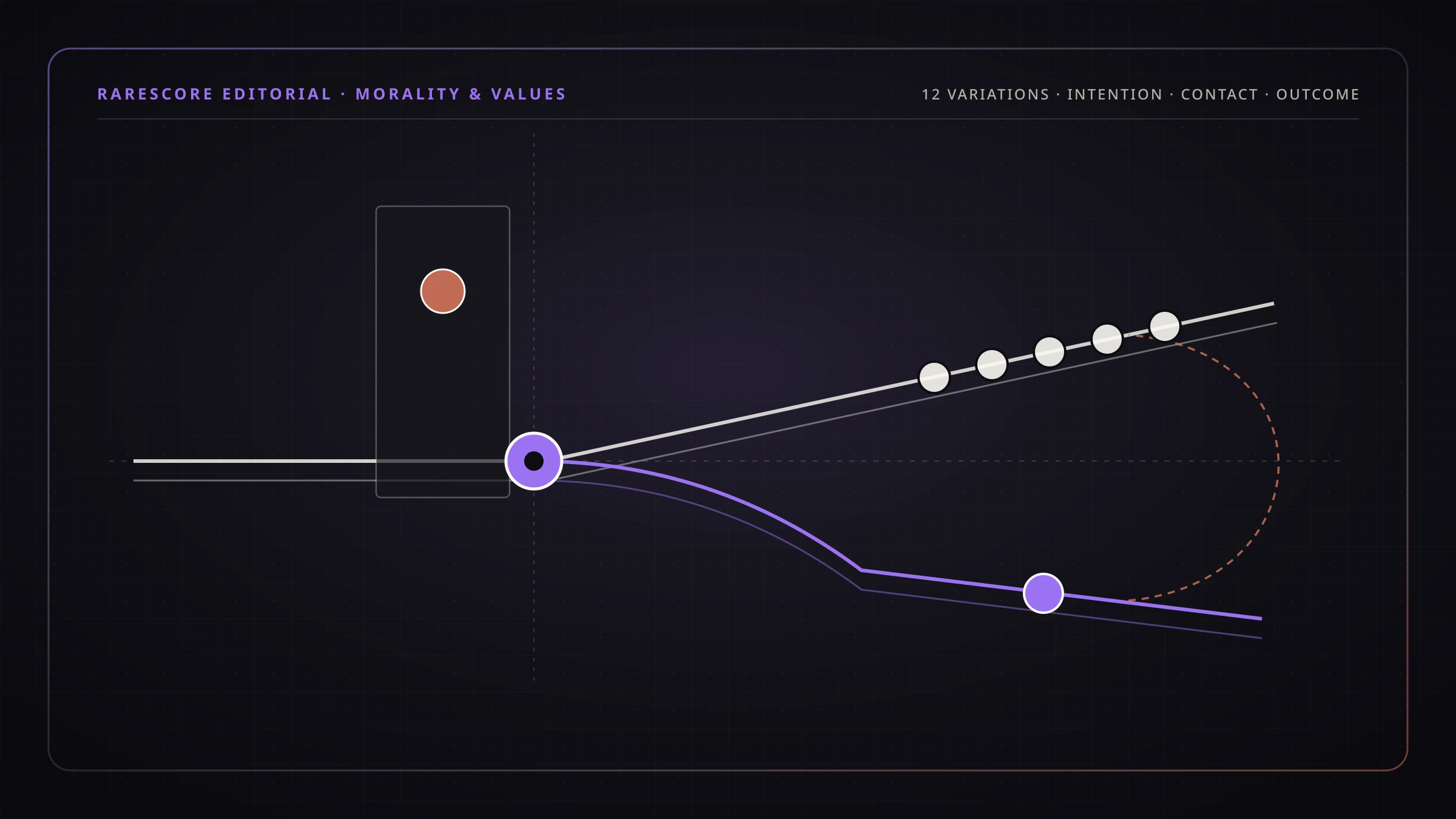
Setup: A runaway trolley is headed toward five people on the main track. You stand beside a lever that can divert the trolley onto a side spur where one person is standing.
Choice: Do nothing (five die) or pull the switch to divert the trolley (one dies, five live).
Many people divert in the switch case. Philosophers and moral psychologists then introduce variants that make the same five-versus-one arithmetic feel completely different. The point is not to crown a single winner. It is to map which principle you protect when numbers alone are not enough: minimize deaths, refuse to use someone as a tool, avoid personal force, respect institutional roles, or demand certainty before acting.
RareScore's morality test is built around value tradeoffs under pressure rather than a single "correct" trolley answer. Use these versions as a thinking tool, not a permanent personality label.
Twelve trolley problem variations
- Switch (bystander at the switch): Divert the trolley from five people to one person using a track lever. Tests outcome-focused harm reduction when personal physical contact is low and the one person's death is a foreseen side effect rather than the mechanism of rescue.
- Footbridge (push or heavy stranger): The same five-versus-one stakes, except there is no side track; you must push a large person off a footbridge onto the tracks so their body stops the trolley. Numbers match the switch case, yet most respondents reverse their answer. Tests personal force and using a person directly as a means.
- Loop track: The side track loops back onto the main track behind the five people, and only the one person's body on the loop prevents the trolley from continuing around and killing the five. Diversion still uses a switch, but the one person's impact is now causally necessary to save the five rather than an incidental side effect.
- Transplant surgeon: A transplant surgeon has five patients dying of organ failure and one healthy checkup visitor whose organs match all five. The numbers are identical to the switch case, with a medical framing and no runaway train. Tests whether institutional roles, consent, and bodily rights block utilitarian arithmetic.
- Fat villain or culpable bystander: The one person on the bridge or side track is the villain who tied the five people to the main track in the first place. Pushing or diverting now feels closer to self-defense or desert for many people, testing whether moral responsibility changes permission to harm.
- Consent or volunteer on the track: The single person on the side track has knowingly agreed to the risk or volunteered to take the spur position. Tests whether informed consent softens the duty not to sacrifice one person for a group.
- Family member on the side track: The five people on the main track are strangers, and the one person on the side track is your child, parent, or partner. Tests special obligations and personal loyalty against impartial harm reduction.
- Uncertainty and probabilistic harm: Pulling the switch is guaranteed to kill the one person on the side spur, whereas the five people on the main track have a chance of hearing the trolley and jumping clear in time. Tests how uncertainty and expected value change intuitions about intervening.
- Trolley driver versus bystander: In one version you are the trolley driver whose job is to steer the train safely; in the other you are a passerby who happens to stand near a switch. Tests whether professional role responsibility makes choosing the lesser evil mandatory rather than optional.
- Self-sacrifice on the track: Diverting the trolley onto the spur kills you instead of five strangers, or you can jump from the bridge yourself to jam the wheels. Tests the asymmetry between sacrificing yourself (often seen as heroic but optional) and imposing death on an unconsenting stranger.
- Autonomous vehicle programming: A self-driving car with failed brakes must choose between swerving into one pedestrian or staying straight into five pedestrians, or between protecting its passenger and protecting pedestrians. Uses the same tradeoff structure in modern engineering ethics, where rules must be written in advance rather than decided in panic.
- Inaction framed as active choice: The prompt describes leaving the lever untouched as "deciding that the five should die" rather than "staying out of it." Tests how omission bias and action framing shift moral judgment even when the physical options are unchanged—related to the mechanisms covered in cognitive biases that affect decisions.
What actually changes between versions
Across all twelve variations, five psychological and philosophical levers do the work:
- Means versus side effect: Is the one person's death the causal instrument that saves the five, or an unwanted side effect of steering danger away?
- Personal force: Pulling a mechanical switch at a distance feels different from using your hands to push someone into harm's way, even when the outcome is identical.
- Rights and institutional roles: Surgeons, train drivers, and bystanders carry different duties and trust expectations in people's moral maps.
- Relationship and desert: Kinship, consent, or culpability for creating the threat routinely outweighs raw headcount.
- Certainty of harm: Guaranteed harm to one person is weighed differently from probable harm to five, making inaction feel safer when outcomes are noisy.
If your answers flip between the switch and the footbridge, that is common across cross-cultural and neuroimaging studies—not simple hypocrisy. It usually means you weigh physical contact and the rule against using a person as a tool alongside total lives saved. For how time pressure and stress shift these choices, see decision-making styles under pressure.
How to use these variations in discussion or self-reflection
- Change one fact at a time—such as relationship, certainty, or consent—and write down which change made your answer flip.
- State the cost your chosen principle accepts, not only the lives it saves.
- In a classroom or seminar, never grade a "correct" trolley answer; grade the clarity of the principle and how directly the student addresses the counter-case (see classroom moral dilemma scripts).
- Separate split-second personal intuition from institutional policy: what a bystander feels able to do in an emergency is not always the rule society wants encoded in hospital triage or vehicle software.
For what structured morality assessments can and cannot claim from dilemma answers, read What Morality Tests Really Measure.
Frequently asked questions
What is the most famous trolley problem variation?
The pairing of the classic switch case with Judith Jarvis Thomson's footbridge case. Both pit one life against five lives, but changing a lever pull to a direct physical push causes many people to reverse their verdict.
Is there a correct answer to the trolley problem?
No single answer is settled across ethical traditions. Consequentialist approaches generally favor minimizing total deaths, while deontological and rights-based approaches often prohibit using an unconsenting person as a means to save others. Productive analysis names both the principle and the cost it accepts.
Are trolley dilemmas the same as a morality test?
No. Trolley cases are extreme, stylized thought experiments built to isolate specific philosophical distinctions. A structured morality test examines patterns across realistic tradeoffs involving honesty, loyalty, fairness, authority, and harm without assigning a "good person" score.
Comparing switch, loop, and footbridge in sequence
Suppose a reader pulls the switch in the classic bystander case and explains their choice with a simple rule: "Always save five lives over one." Next they read the footbridge variation and refuse to push the stranger onto the tracks. If the only principle at work were body count, the two answers would match. Because they diverge, something else is operating alongside outcome math.
Now introduce the loop track as the middle step. In the loop version, you still pull a mechanical switch from a distance, so personal force is removed, yet the one person's body is still required to stop the train from reaching the five. Readers who pull the switch in the loop case are responding primarily to personal physical contact; readers who refuse in the loop case are responding to the rule against using a person's body as the instrument of rescue. Walking through those three cases in order turns a gut reaction into an inspectable moral rule.
Use this checklist
- Did you hold the five-versus-one outcome constant while changing only one structural feature?
- Can you state whether the one person's harm is a side effect or the direct means of saving the five?
- Did you check whether personal physical force or a mechanical intermediary changed your answer?
- Have you tested whether role duty, consent, or family relationship overrides the headcount?
- Did you separate emergency personal intuition from the rule you would endorse as public policy?
What the evidence supports
Trolley problem variations endure because they make hidden moral rules visible: when you hold the numbers still and alter the action, you discover where outcome math stops and duties of rights, contact, loyalty, or role responsibility begin. If you want to explore how your own value tradeoffs behave across thirty concrete scenarios rather than a single rail puzzle, take RareScore's free morality test and review the scoring limits in our methodology.
About the RareScore Research Desk
This guide was reviewed for claim strength, source quality, originality, and practical usefulness. The Research Desk is an editorial function, not a licensed clinical service. See the editorial standards and writing-process disclosure.
Sources and further reading
- Foot, P. (1967). The Problem of Abortion and the Doctrine of the Double Effect — Oxford Review
- Thomson, J. J. (1985). The Trolley Problem — Yale Law Journal
- Greene, J. D., Sommerville, R. B., Nystrom, L. E., Darley, J. M., & Cohen, J. D. (2001). An fMRI Investigation of Emotional Engagement in Moral Judgment — Science
- McConnell, T. Moral Dilemmas — Stanford Encyclopedia of Philosophy
- APA Dictionary of Psychology — Moral Dilemma