Decision making • 5 min read • By RareScore Research Desk
12 Cognitive Biases That Quietly Change Your Decisions
Learn how confirmation bias, anchoring, sunk costs, availability, overconfidence, framing, and other biases affect everyday judgment.
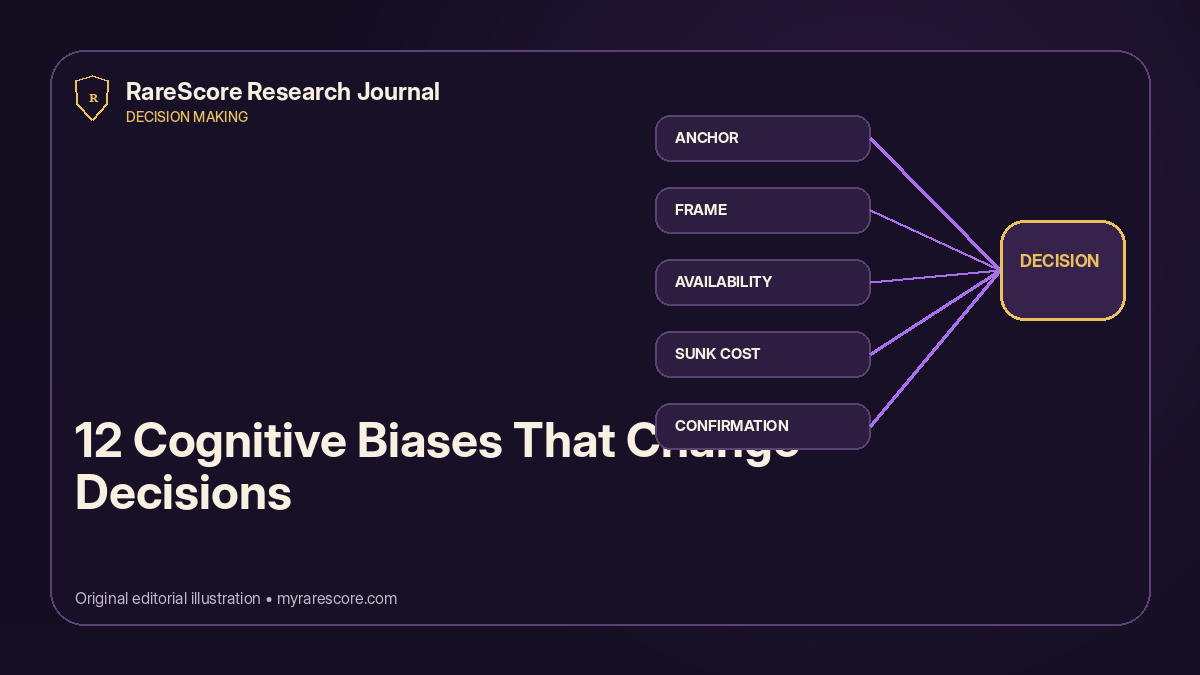
What to know before reading further
- A bias is a systematic tendency, not a diagnosis and not an error on every occasion.
- The same shortcut can be efficient in one setting and misleading in another.
- Debiasing works best when tied to a specific trigger and decision process.
- Checklists, base rates, pre-mortems, and independent estimates can reduce selected biases.
This guide answers: Recognize common decision biases, the conditions that trigger them, and practical ways to reduce their influence.
Knowing the name of a bias is not debiasing
Bias lists can create a new form of overconfidence: once people recognize anchoring or confirmation bias in others, they assume they are less vulnerable themselves. The practical unit of change is not the label but the decision procedure. Which judgments are made before independent estimates? Which evidence would count against the preferred conclusion? When is a base rate required?
A useful anti-bias system attaches a safeguard to a predictable trigger. High emotion triggers a pause. Large forecasts trigger an outside-view comparison. Group enthusiasm triggers anonymous estimates. Prior investment triggers a fresh evaluation of future value. The safeguard should operate before confidence hardens.
A cognitive bias is a predictable shortcut, not proof of stupidity
Human judgment must operate with limited time and information. Shortcuts make decisions possible, but they can also create systematic errors. Intelligence does not remove bias; in some situations, stronger reasoning can help a person defend the conclusion they already prefer.
The practical goal is not to eliminate every shortcut. It is to recognize situations where the shortcut is likely to produce a costly mistake.
1. Confirmation bias
Confirmation bias is the tendency to seek, interpret, and remember information that supports an existing belief. It becomes especially strong when the belief protects identity, loyalty, or status.
Counter it by asking what evidence would genuinely change your mind and by searching for the strongest opposing explanation rather than the weakest one.
2. Anchoring
The first number or frame presented can pull later estimates toward it, even when the anchor is arbitrary. Initial prices, salary expectations, and early diagnoses can shape the entire conversation.
Create an independent estimate before seeing the anchor when possible. In negotiations, research a range rather than reacting only to the first offer.
3. Availability bias
Events that are vivid, recent, or easy to remember feel more common than they are. A dramatic story can outweigh quiet statistical evidence.
Ask whether the example is representative or merely memorable. Base-rate information is often less emotional but more reliable.
4. Sunk-cost effect
Past investments of time, money, or pride can keep people committed to a failing path. The cost has already occurred, but abandoning the project feels like admitting waste.
Reframe the decision: if you had not invested anything yet, would you choose this option today? Future costs and benefits should carry more weight than unrecoverable past costs.
5–8. Framing, loss aversion, status quo, and overconfidence
The same outcome can feel different when presented as a gain or a loss. People often work harder to avoid losing something than to gain an equivalent amount. The existing option also receives an advantage simply because change creates uncertainty.
Overconfidence adds another layer: people may underestimate the range of possible outcomes and overestimate the accuracy of their own knowledge.
- Rewrite the choice in both gain and loss language
- Compare the current option as if it were a new proposal
- Use ranges instead of one confident forecast
- Ask what failure would look like before committing
9–12. Halo effect, groupthink, fundamental attribution error, and self-serving bias
The halo effect lets one positive quality influence unrelated judgments. Groupthink suppresses disagreement to preserve harmony. The fundamental attribution error overemphasizes personality when explaining other people while underestimating their circumstances. Self-serving bias credits success to ourselves and failure to outside forces.
These biases matter most in teams and relationships. Slow down explanations of motive, invite dissent before consensus forms, and use the same standard for your own behavior and someone else’s.
Build a decision system instead of relying on willpower
Bias awareness helps, but checklists and process design are stronger. Use premortems, independent estimates, written criteria, cooling-off periods, and a designated person who argues the opposite case.
The right question is not “Am I biased?” Everyone is. Ask which bias this situation is most likely to activate and what procedure reduces its influence.
Base-rate neglect and the planning fallacy
Base-rate neglect occurs when a vivid individual story outweighs general statistical information. The planning fallacy appears when people underestimate time and cost despite knowing that similar projects were late before.
Before forecasting, examine comparable cases. Use the outside view: how long did projects like this usually take, and how often did choices like this succeed?
A five-question bias check before an important decision
A short checklist can interrupt several biases at once. Write the answers before discussing the decision with people who already know your preference.
- What evidence would make me choose differently?
- What is the relevant base rate?
- Am I protecting a past investment?
- How would I describe this choice if the gains and losses were reversed?
- What would a smart critic say I am ignoring?
Attach each bias to a safeguard
For anchoring, require an independent estimate before viewing a seller’s price or another person’s forecast. For confirmation bias, write down what evidence would change the conclusion. For availability, compare vivid examples with base-rate data. For sunk cost, ask whether you would enter the project today at its current price and prospects.
For overconfidence, express the forecast as a range and track calibration over time. For framing, restate the same outcome as gains and losses. For groupthink, collect judgments before discussion. For the planning fallacy, compare the project with a reference class of similar projects rather than the ideal internal plan.
These safeguards do not remove bias. They change the environment in which the judgment is made. That is more reliable than expecting awareness alone to overpower a shortcut at the exact moment it feels most convincing.
Use this checklist
- Attach each named bias to a concrete safeguard.
- Collect independent estimates before group discussion.
- Use base rates and reference classes for forecasts.
- State what evidence would reverse the preferred conclusion.
- Evaluate future value without counting sunk costs.
What the evidence supports
The practical response to bias is architecture. Build decisions so that important information appears before commitment, disagreement is possible before status becomes attached, and forecasts can be compared with outcomes. No checklist creates perfect rationality. It can, however, make predictable errors less convenient and corrective evidence harder to ignore.
About the RareScore Research Desk
This guide was reviewed for claim strength, source quality, originality, and practical usefulness. The Research Desk is an editorial function, not a licensed clinical service. See the editorial standards and writing-process disclosure.