Personality science • 5 min read • By RareScore Research Desk
Personality Test Questions: What Different Formats Actually Measure
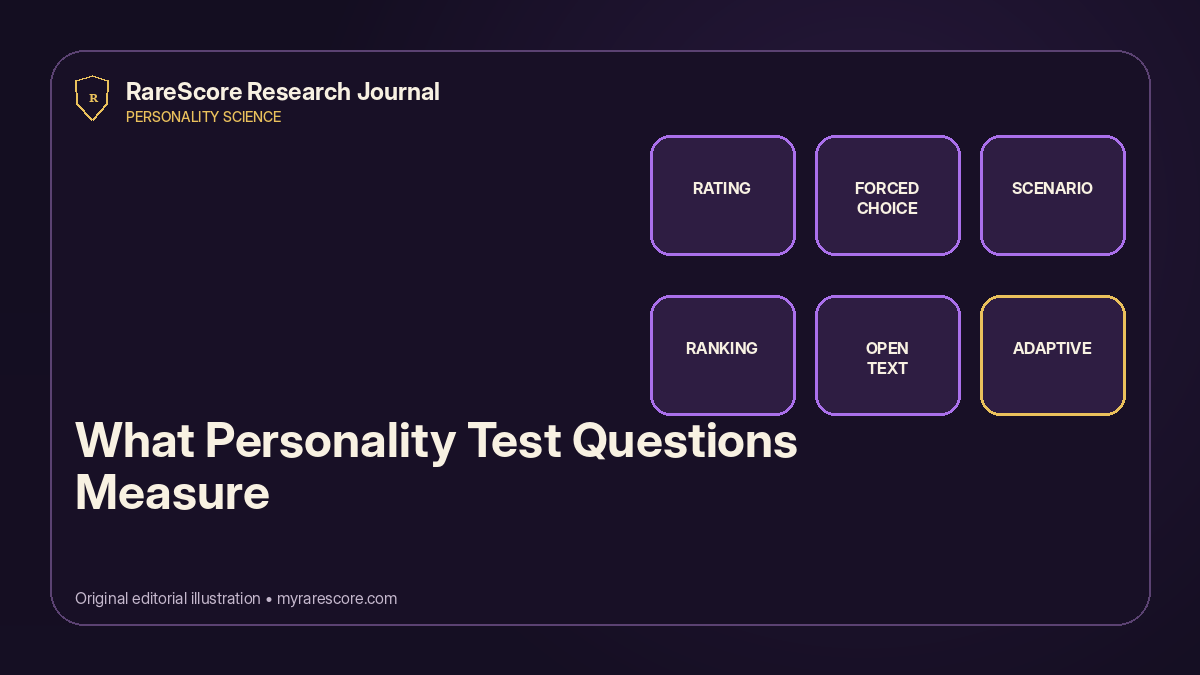
Learn how direct ratings, forced choices, scenarios, rankings, open responses, and adaptive follow-ups reveal different parts of personality.
What to know before reading further
- Direct ratings are efficient but vulnerable to self-presentation and interpretation differences.
- Forced choices reveal relative preference only when options are balanced in desirability.
- Scenarios add context but can confuse values, motives, and beliefs about consequences.
- Open responses can add nuance, yet they should never carry the entire interpretation.
This guide answers: Compare rating scales, forced choices, scenarios, rankings, open responses, and adaptive follow-ups.
Every question format is a sensor with a noise profile
A direct rating asks the respondent to summarize themselves. A scenario asks them to imagine behavior under specified conditions. A forced choice asks which tendency wins when both cannot be selected. An open response samples language, association, and self-presentation. None of these formats reveals personality directly; each produces evidence distorted in a different way.
Good assessment design combines sensors whose weaknesses do not all point in the same direction. If direct ratings suggest generosity but resource-allocation scenarios repeatedly favor self-interest, the disagreement is information. The task is not to choose the more flattering source but to investigate whether context, interpretation, or presentation explains the gap.
Question format changes the evidence a test collects
A statement such as “I am organized” asks for a self-judgment. A scenario about a missed deadline asks the person to choose a behavior. A forced choice asks which of two attractive qualities is more characteristic. These formats do not produce identical information.
A strong assessment mixes formats because every method has weaknesses. Direct questions are efficient but easy to manage. Scenarios feel realistic but depend on how the situation is understood. Open responses reveal language and association but require cautious interpretation.
Direct rating scales
Rating scales ask how strongly a person agrees with a statement or how often a behavior occurs. They are common because they are easy to administer and score.
The main risks are social desirability, response habits, and different interpretations of words such as often or confident. Multiple items should support each conclusion.
Forced-choice questions
Forced-choice items ask the person to choose between two statements that may both sound desirable or undesirable. This makes it harder to select the obviously flattering response every time.
The choices must be balanced carefully. If one option is clearly more admirable, the item measures impression management more than personality.
Scenario questions
Scenarios place values and motives into context. A public insult can reveal a different response from private criticism; a betrayal by a friend can activate different priorities from the same behavior by a stranger.
One scenario should not determine a trait. The result should look for repeated patterns across several situations and follow up when the same choice has multiple possible motives.
Ranking and allocation questions
Rankings force tradeoffs among priorities such as honesty, harmony, loyalty, independence, and achievement. Allocation tasks can ask the user to divide limited points across motives.
These formats reveal relative priority, but they can frustrate users when the options feel incomparable. Clear wording and a small number of items help.
Open-ended and association questions
Open responses can capture specificity, abstraction, emotional tone, and unusual associations. They can also be random, performative, or influenced by language skill.
Automated interpretation should be limited, transparent, and supported by structured answers. A single poetic response should never become a diagnosis or a dramatic personality claim.
Adaptive follow-ups ask what the first answer meant
When an answer supports several explanations, the next question can separate them. Refusing money at the cost of a relationship might reflect loyalty, guilt, fear of loneliness, responsibility, or identity. The action alone does not reveal the motive.
Adaptive testing becomes valuable when the branch is designed around competing hypotheses rather than merely making the quiz feel personalized.
Visual choices and response time require restraint
Images can reduce reading burden and capture preference, but visual meaning is influenced by culture, accessibility, color vision, and design. A picture should not be treated as a universal psychological symbol.
Response time can help identify random clicking or uncertainty when combined with other evidence. It should not be used alone to label someone impulsive, dishonest, or careless.
A quality checklist for personality questions
The wording should be understandable, relevant to the intended construct, and free from an obvious “good person” answer. The full bank should cover both ends of a trait and more than one context.
Question performance should be reviewed after launch. Items that confuse users, create excessive dropout, or fail to distinguish patterns should be revised or retired with version history preserved.
- One clear idea per question
- Balanced answer desirability
- No diagnosis hidden in ordinary wording
- Multiple items supporting major conclusions
- Accessible language and mobile layout
- Versioning and item-performance review
Compare two formats measuring the same idea
A direct item might ask, “I remain calm when criticized.” The response depends on self-knowledge, the meaning of “calm,” memory, and the desire to present well. A scenario might describe public criticism by a colleague and ask what happens next. The scenario adds context but also introduces beliefs about workplace norms and the imagined colleague.
A forced-choice pair might ask whether the person is more likely to defend the record immediately or gather information privately. This reveals relative preference but forces a tradeoff that may not exist in real life. An open response may reveal nuance, but scoring becomes less standardized and more sensitive to language.
When several formats converge, confidence rises. When they disagree, the disagreement should trigger a follow-up rather than be averaged away. The test may have discovered a context shift, a self-presentation gap, or a poorly written item.
Use this checklist
- Match each question format to the evidence it can provide.
- Balance forced-choice options for desirability.
- Use scenarios to test context, not to infer motives automatically.
- Treat open-text analysis as supporting evidence.
- Investigate disagreement across formats instead of averaging it away.
What the evidence supports
Assessment quality improves when designers treat formats as complementary evidence rather than interchangeable decoration. A slider, scenario, forced choice, and open response each impose different cognitive and social demands. Their agreement can strengthen a conclusion; their disagreement can expose context or bias. The test becomes more intelligent when it investigates the disagreement instead of hiding it inside an average. Question quality is ultimately demonstrated at the scale level. A clever item can still be useless if it duplicates existing information, behaves differently across groups for irrelevant reasons, or contributes to a score that cannot be interpreted consistently. Reviewers should examine the full evidence chain: construct definition, item behavior, reliability, validity, fairness, response process, and the consequences of using the resulting score.
About the RareScore Research Desk
This guide was reviewed for claim strength, source quality, originality, and practical usefulness. The Research Desk is an editorial function, not a licensed clinical service. See the editorial standards and writing-process disclosure.