Personality science • 6 min read • By RareScore Research Desk
How Adaptive Personality Tests Work
A clear explanation of branching questions, latent traits, information gain, confidence, item exposure, and why different people receive different questions.
What to know before reading further
- Adaptive testing selects the next question from the evidence already collected.
- The first answer often creates competing explanations; follow-ups should separate those explanations.
- A serious adaptive system needs calibrated items, coverage rules, exposure controls, and a defensible stopping rule.
- Before sufficient response data exists, a transparent rule-based or Bayesian hybrid is more honest than claiming full psychometric calibration.
This guide answers: Learn how branching questions, latent traits, item information, and stopping rules create an adaptive personality assessment.
Real adaptation resolves ambiguity
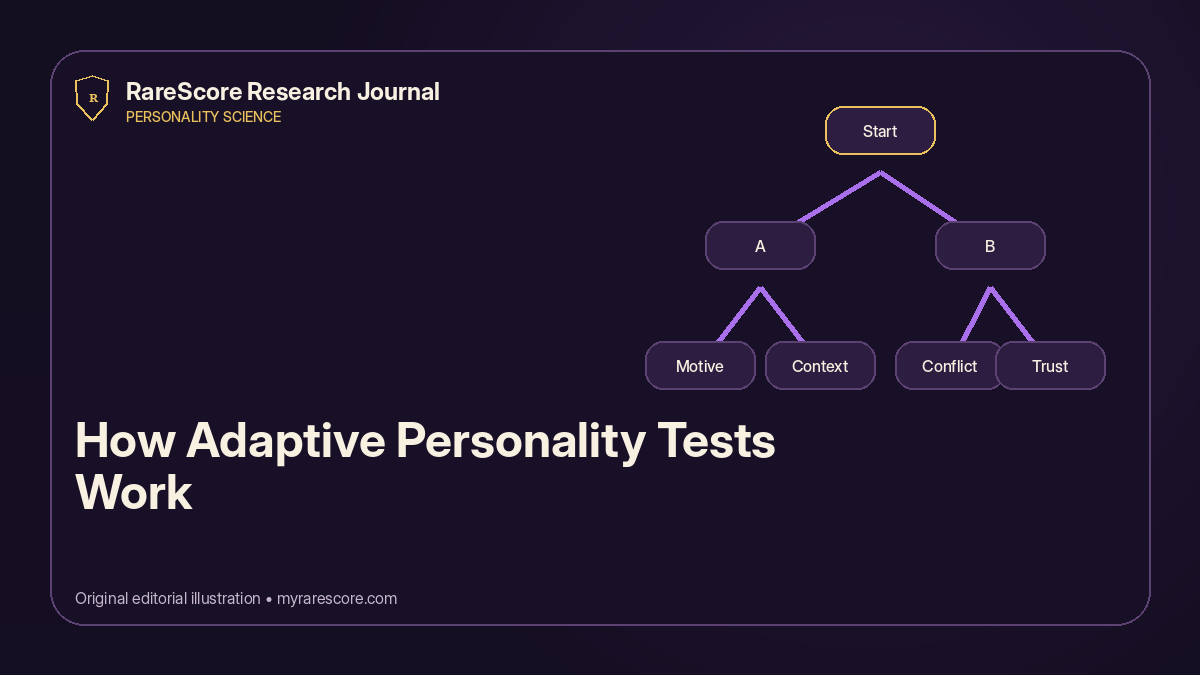
A branching quiz is not automatically an adaptive assessment. Many sites simply route “yes” to one themed question and “no” to another. That changes the experience, but it may not improve the measurement. Genuine adaptation begins with uncertainty: the first answer is compatible with several motives, traits, or contexts, and the next item is chosen because it is expected to separate those explanations.
Consider a person who refuses a lucrative opportunity that would damage a close relationship. The refusal might reflect loyalty, guilt, fear of abandonment, moral duty, or a belief that the opportunity is unsafe. A useful follow-up asks which cost mattered. A weak follow-up merely asks another loyalty question. The difference is subtle on the screen but fundamental in the model: one branch narrows a hypothesis; the other repeats a theme.
A fixed test asks everyone the same thing
Traditional questionnaires present the same items in the same order. That makes administration simple, but it can waste questions on traits that are already clear while leaving contradictions unresolved.
An adaptive assessment updates an internal profile after each response and chooses the next item according to what remains uncertain. Two people may begin with the same question and follow different paths by question two.
The test estimates patterns that cannot be observed directly
Traits such as trust, autonomy, strategic patience, or approval sensitivity are latent variables. They are not visible in the way height is visible. The system infers them from repeated choices across different situations.
One answer should create a hypothesis, not a conclusion. Declining a confrontation could indicate empathy, fear, patience, low investment, or strategy. A follow-up question is useful only when it separates those explanations.
The next question should add information
Computerized adaptive testing is built around item selection. In a calibrated system, the next question is often chosen because it provides high information at the person’s current estimated level. In a personality setting, the same idea can be extended to unresolved motives and context changes.
A practical launch version may combine statistical updating with expert-defined branching. As response data grows, item parameters can be recalibrated and weak questions can be retired.
Good adaptation needs constraints
Always choosing the mathematically most informative item can create a repetitive or unbalanced experience. A useful engine also protects content coverage, varies formats, limits overexposure, and prevents the same trait from being tested several times in a row.
- Coverage: every major dimension receives enough evidence
- Variety: scenarios, forced choices, sliders, rankings, and open responses
- Exposure control: no tiny set of questions appears for everyone
- Fatigue control: difficult formats are spaced apart
- Evidence rules: strong conclusions require support across contexts
Why calibration matters
A true psychometric adaptive test needs data. Item difficulty, discrimination, and response patterns cannot be known perfectly before people answer the questions. New items are usually piloted, monitored, and adjusted.
Until sufficient data exists, responsible sites should describe the system as research-inspired or beta rather than clinically validated.
Adaptation should be felt, not announced constantly
The user should notice that the test stays relevant and avoids repetition. The interface can briefly say that the path changes, but the main proof is the experience itself: a response about trust leads to a more precise trust question, while a response about status leads somewhere else.
The result should then show evidence. Adaptation without explainability can feel like a magic trick. Adaptation with evidence becomes a useful model of the person’s decisions.
How the next question is selected
An adaptive engine can score every eligible question according to expected usefulness. It may prioritize a trait with high uncertainty, a motive that has several competing explanations, a context that has not been tested, or a contradiction that would materially change the report.
Good selection rules also control repetition and fatigue. Asking five nearly identical trust questions may raise confidence mechanically while making the test feel boring. Format variety and content coverage are therefore part of the design, not decoration.
Why real response data still matters
Expert weights are a practical starting point, but they are not a substitute for calibration. After enough serious completions, developers can examine item discrimination, branch frequency, drop-off, response time, consistency, and whether the same construct is being measured across groups.
Items that contribute little information should be revised or removed. New questions can be introduced gradually and compared against established anchors. Version tracking is essential so results produced by different scoring systems are not silently mixed.
- Track the question-bank and scoring-engine version
- Limit exposure of protected validation items
- Review whether branches create unequal test difficulty
- Collect section-level accuracy feedback
- Recalibrate before publishing population percentiles
Common questions
Does adaptation mean the test is manipulating the result? Not when the selection rules are documented. Adaptation changes which evidence is collected; it should not secretly push everyone toward a preferred label.
Can two people receive the same result through different paths? Yes. The final pattern may converge even when the evidence came from different scenarios. A good report stores the path and confidence behind the conclusion.
Why keep exactly 30 questions? A fixed completion length gives users a predictable experience while still allowing the content of those 30 positions to adapt.
What a useful branch looks like
Suppose the test asks whether you would expose a close friend who took credit for your work. Choosing not to expose them could indicate loyalty, conflict avoidance, strategic patience, fear of social loss, or indifference to recognition. A useful adaptive engine does not immediately score the answer as “loyal.” It stores several hypotheses and selects a follow-up that creates separation.
One follow-up might ask what would bother you most: losing the friendship, allowing the false story to stand, appearing weak, starting a public conflict, or receiving no private repair. A later question might change the relationship from friend to stranger while keeping the harm constant. If the response changes, relationship loyalty matters. If it does not, the pattern may be more strongly about conflict, status, justice, or control. By the end, the report should be able to state both the pattern and the evidence path that made one explanation more likely than the alternatives.
Use this checklist
- Ask what uncertainty each follow-up is designed to reduce.
- Require coverage across traits, motives, and situations.
- Prevent one dramatic answer from controlling the report.
- Version questions and preserve the scoring history.
- Calibrate item behavior when enough real response data exists.
What the evidence supports
The user should feel that later questions understand the problem more precisely, not merely that the quiz is changing scenery. Behind the interface, each branch should earn its place by resolving an ambiguity, restoring missing coverage, checking a contradiction, or improving report evidence. Adaptation is successful when the final explanation is narrower, more inspectable, and less dependent on generic language than a fixed questionnaire would have produced.
About the RareScore Research Desk
This guide was reviewed for claim strength, source quality, originality, and practical usefulness. The Research Desk is an editorial function, not a licensed clinical service. See the editorial standards and writing-process disclosure.