Rarity & identity • 6 min read • By RareScore Research Desk
What Actually Makes a Personality Rare?
Why unusual answers are not enough, how trait combinations create rarity, and why a complete profile can be uncommon even when individual traits are ordinary.
What to know before reading further
- A rare answer is not the same as a rare personality.
- The most informative rarity estimate considers combinations, correlations, context shifts, and uncertainty.
- Small or biased samples cannot justify population-wide percentile claims.
- Rarity has descriptive value; it does not automatically mean better, deeper, or more valuable.
This guide answers: Understand the difference between an extreme trait, an uncommon trait combination, and a rare context-dependent pattern.
Rarity is a density question
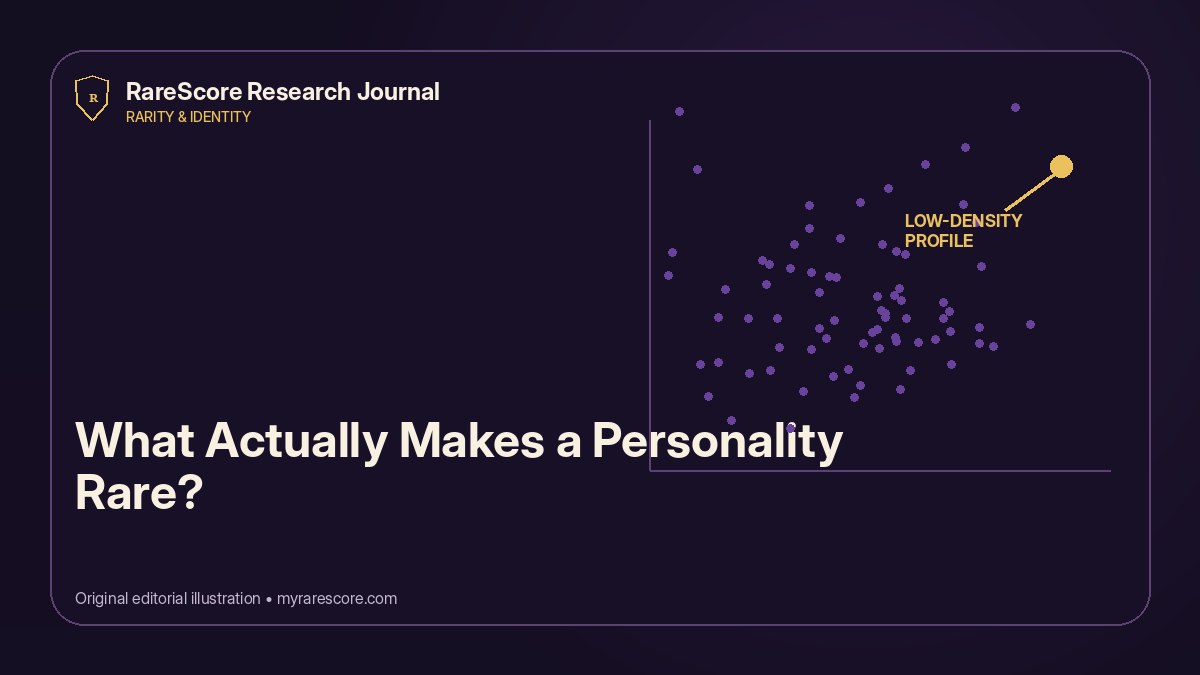
A profile is not rare because it contains several high scores. It is rare when relatively few people occupy a similar region of the joint distribution. That distinction matters because traits are correlated. High curiosity and openness may frequently occur together; counting each as an independent rarity exaggerates the result. Conversely, a moderate combination can be unusual if the traits rarely coexist in that arrangement.
The honest statistical question is therefore: how densely populated is the neighborhood around this complete profile, given the sample we actually observed? The honest interpretive question is: how much uncertainty remains because the sample is small, self-selected, culturally narrow, or still changing? A rarity score that suppresses those questions is marketing. A useful rarity estimate makes them part of the result.
Rarity is not the same as choosing the strangest answer
A test becomes easy to manipulate when the unusual-looking option always earns more rarity points. People can simply perform uniqueness. A better model asks how uncommon the complete pattern is.
An answer can be rare because few people choose it, but it should contribute only one piece of evidence. Randomness, misunderstanding, and deliberate contrarianism can also produce unusual answers.
Combinations matter more than isolated traits
A person may be moderately high in empathy, dominance, discipline, and risk tolerance. None of those scores is extraordinary alone, but the combination may be uncommon.
Statistically, this is a density problem: how many similar profiles exist nearby? A profile in a sparse region of the data can be unusual even when it has no single extreme score.
Context patterns can be rare too
Some people change very little across situations. Others become dramatically different under public evaluation, intimacy, competition, or uncertainty. The pattern of change can be more distinctive than the average trait score.
For example, someone may be reserved with strangers, highly dominant with close friends, calm during practical risk, and emotionally reactive to betrayal. That structure tells a more specific story than “introverted.”
Open responses need safeguards
One-word associations and short written answers can reveal originality, emotional themes, and abstraction. But a strange answer is not automatically meaningful. A credible system must separate semantic rarity from nonsense.
Open text should support a result, not dominate it. It also requires privacy controls and a clear warning not to enter identifying information.
Rarity requires a reference sample
A percentile can only describe a specific comparison group. A new website should not claim that someone is rarer than 99% of humanity without population data.
Early results should be labeled as estimated pattern rarity within the model. Once the site has enough serious completions, it can report percentiles among RareScore participants and explain the sample size.
Rare does not mean superior
Common traits can be extremely useful. Rare combinations can create both advantages and costs. The purpose of a rarity score should be curiosity and self-understanding, not a hierarchy of human value.
The most interesting question is not “Am I special?” It is “Which combination of motives and decisions makes my pattern less common—and what does that combination require from me?”
Three statistical views of rarity
Answer rarity counts how infrequently one response appears. Trait rarity measures distance from the center on a dimension. Profile rarity asks how densely populated the surrounding combination is. These are different questions and should not be collapsed without explanation.
A profile score also needs smoothing and minimum sample rules. If only a handful of people have completed a branch, an extreme percentile can reflect unstable data rather than a truly uncommon pattern.
How rarity should be displayed honestly
The result should identify the comparison group, sample size, model version, and confidence. Early in a product’s life, “estimated pattern rarity” is more defensible than “rarer than 99% of people.”
Rarity should also be separated from desirability. A common pattern can be adaptive and generous; an uncommon pattern can be difficult to live with.
- Show the reference population
- Publish the minimum sample threshold
- Shrink uncertain estimates toward the average
- Separate answer rarity from profile rarity
- Avoid treating rarity as moral or intellectual superiority
Common questions
How many completions are enough for a percentile? There is no universal number. It depends on the stability of the distribution, branch sample sizes, and whether the participants resemble the population being described.
Can someone increase their rarity score intentionally? They can choose unusual answers, but a strong model uses consistency, motive follow-ups, semantic quality, and complete-profile density to reduce simple gaming.
Does rarity stay constant? Not necessarily. People change, the reference sample changes, and better calibration can revise the estimate.
Why a collection of extreme scores can still be ordinary
Imagine a profile with high openness, high curiosity, strong preference for novelty, and unconventional interests. Each score may be far from the average, but the combination may be common because those traits tend to travel together. Treating them as four independent rarities would count the same underlying pattern repeatedly.
Now consider a different profile: high social dominance, high empathy, low approval seeking, high forgiveness, and strong willingness to confront unfairness. None of the scores must be extreme. The combination may nevertheless occupy a sparsely populated region because dominance often co-occurs with lower accommodation, while forgiveness and confrontation do not always rise together. This is where multivariate methods become more informative than adding “unusual” points.
The sample still controls the claim. A site whose participants are mostly young, English-speaking, and interested in personality tests cannot honestly describe its result as a universal human percentile. It can report rarity among current participants, show the sample size, smooth unstable estimates, and revise the percentile as the reference population grows. That restraint makes the number more credible, not less interesting.
Use this checklist
- Separate unusual answers from unusual trait combinations.
- Account for correlations before adding rarity points.
- State the sample size and who is represented.
- Shrink unstable estimates toward the average.
- Report rarity as description, not superiority.
What the evidence supports
A rigorous rarity result should become more conservative when the evidence becomes weaker. Small samples, changing populations, unstable open-text classifications, and inconsistent responses should pull estimates toward the center rather than reward novelty. That may produce fewer spectacular claims, but it creates a score that can improve as the reference data grows—and a brand that does not need to invent certainty to remain interesting.
About the RareScore Research Desk
This guide was reviewed for claim strength, source quality, originality, and practical usefulness. The Research Desk is an editorial function, not a licensed clinical service. See the editorial standards and writing-process disclosure.