Decision making • 5 min read • By RareScore Research Desk
How to Make Better Decisions Under Pressure
Use a practical pressure-decision framework to slow impulsive reactions, identify the real threat, compare options, and protect long-term values.
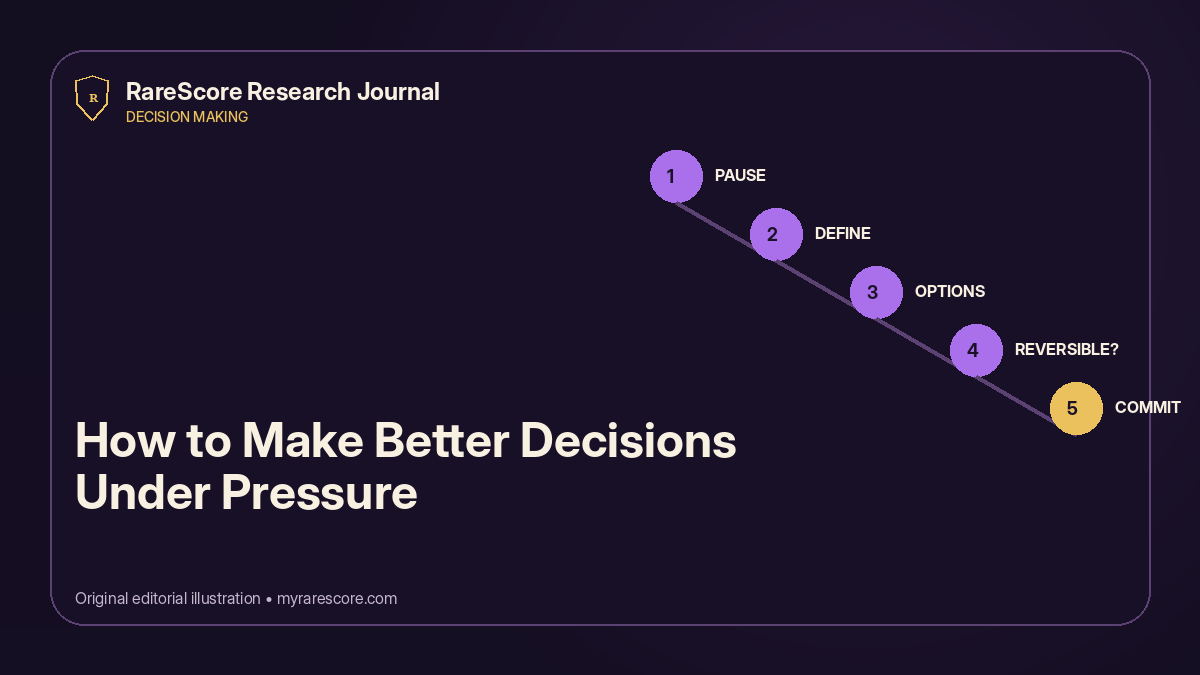
What to know before reading further
- First reduce avoidable physiological and informational noise.
- Define the decision in one sentence and separate facts from predictions.
- Identify which choices are reversible, time-sensitive, or catastrophic if wrong.
- Use a preselected protocol before the pressure arrives.
This guide answers: Apply a short protocol for urgent decisions when stress narrows attention and time.
Protect the architecture, not the feeling
Waiting to feel calm is not a reliable pressure strategy. In many real decisions, the body remains activated and the deadline remains real. The objective is to protect a small architecture of thought: define the decision, distinguish facts from forecasts, identify irreversible harms, generate one additional option, and assign ownership.
A protocol matters because pressure changes what feels relevant. Urgency makes immediate relief look like success; status threat makes public control look essential; fear of loss makes delay feel safer than it is. The protocol preserves questions that the stressed mind is most likely to drop.
Pressure changes the decision before it changes the answer
Under pressure, attention narrows. People search for immediate control, fast certainty, or relief from discomfort. That can make the first available action feel necessary even when a better option would appear after a short pause.
The goal is not to become emotionless. Pressure contains information. The skill is separating the signal from the protective reaction it triggers.
Step 1: create a small pause
A useful pause can be ten seconds, one night, or a scheduled review depending on the stakes. The pause should be long enough to interrupt automatic behavior but short enough to avoid disguised procrastination.
Use a physical action: write the decision, take one slow breath, leave the reply in drafts, or say that you need five minutes. A planned pause is easier to use than hoping calmness appears automatically.
Step 2: name the threat you are reacting to
Ask what feels endangered: safety, status, belonging, control, fairness, identity, or time. Two people can face the same event but react to different perceived threats.
Naming the threat prevents you from treating every uncomfortable feeling as evidence that immediate action is required.
Step 3: separate facts, assumptions, and predictions
Write three columns. Facts are directly known. Assumptions are interpretations. Predictions are beliefs about what will happen next. Pressure often turns assumptions into facts and worst-case predictions into certainty.
Identify the single missing fact that would most change the decision. If it can be obtained quickly, gather it before acting.
Step 4: generate at least three options
Binary thinking becomes stronger under stress. The mind offers attack or withdraw, confess or hide, accept or quit. A third option often restores flexibility.
Include one reversible option. When uncertainty is high, a choice that preserves future options can be more valuable than the choice that feels most decisive.
Step 5: test the options against values and consequences
Ask which option you would defend publicly, which you would choose if pride were removed, and which future version of you would respect. Then consider the cost to other people and the possibility that your information is wrong.
This is not about finding a perfect answer. It is about preventing one urgent feeling from making the entire decision.
Step 6: run a short premortem
Imagine that the chosen option failed badly. What caused the failure? This question surfaces risks that confidence and momentum hide.
Finish by writing the first warning sign that should trigger reconsideration. A good decision process includes a way to update rather than defend the original choice forever.
Pressure decisions in teams need a different structure
Groups can move too slowly because everyone waits for permission, or too quickly because disagreement feels disloyal. Assign a decision owner, a deadline, and one person responsible for presenting the strongest contrary case.
Separate consultation from authority. People should know whether they are giving input, sharing risk information, or making the final decision. Ambiguity about roles creates conflict after the outcome.
Review the process after the outcome
A good outcome can come from a poor decision, and a bad outcome can follow a reasonable choice under uncertainty. Review what was known at the time rather than judging only with hindsight.
Record which assumption failed, which warning sign was missed, and which part of the process should change. This turns pressure into data instead of shame.
A six-line pressure card
Write a protocol that can fit on a phone screen: What decision must be made? What is known? What is only predicted? What harm is irreversible? What option have we not considered? Who owns the next action? Under pressure, a short card is more usable than a long philosophy.
Add domain-specific triggers. In conflict, prohibit major decisions while either person is insulting or threatening. In business, require a second estimate before committing above a defined amount. In medical or legal emergencies, identify the professional or service to contact rather than relying on a generic self-help procedure.
After the event, review process separately from outcome. A good decision can end badly because of uncertainty, and a reckless decision can end well by luck. Improvement comes from strengthening the process that was available at the time.
Use this checklist
- Write the decision in one sentence.
- Separate known facts from predictions.
- Identify irreversible harm and reversible options.
- Generate one option beyond fight, flight, or delay.
- Assign the next action and review time.
What the evidence supports
A pressure protocol should be practiced before it is needed and short enough to survive the moment. It will not remove emotion or guarantee the outcome. It preserves a minimum standard of thought when urgency is trying to replace the decision with immediate relief. That is often the realistic difference between acting quickly and acting blindly. Preparation should include decision rights and stopping rules. Decide in advance who can call a pause, what new fact would reopen the choice, and which threshold is unacceptable even when the group is tired or embarrassed. Under pressure, people often continue because changing course feels like admitting failure. A precommitted review point converts reconsideration from a personal defeat into part of the process. This is process discipline, not hesitation. It protects judgment when emotion and momentum make revision hardest. The review point should be visible before the crisis begins, assigned to a real person, and tied to evidence rather than mood.
About the RareScore Research Desk
This guide was reviewed for claim strength, source quality, originality, and practical usefulness. The Research Desk is an editorial function, not a licensed clinical service. See the editorial standards and writing-process disclosure.